New from 1694-1702: Induction ceremony documents for the Order of the Golden Fleece. Part II (text)

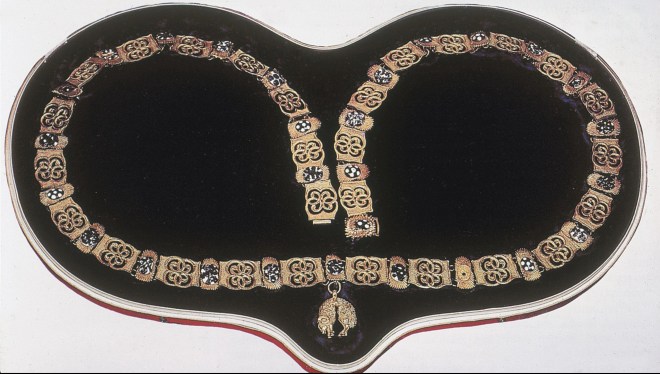
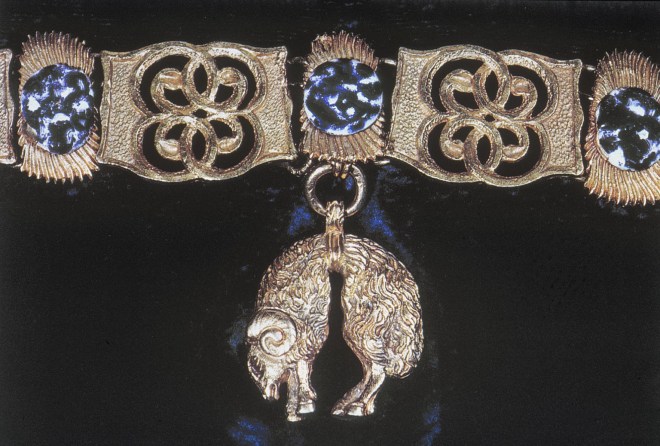
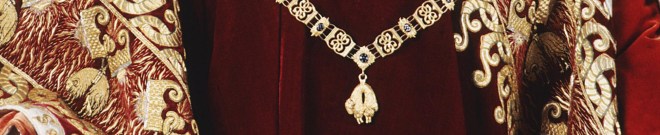
Robes and collar for a Knight of the Order of the Golden Fleece: Austria, 1755. ARTstor Slide Collection

By Madhumita Kaushik (Rutgers ’20)

The first part of this post focused on a spectacular unpublished diploma of 25 June 1702 recently found in the HSH Prince Nicolò and HSH Princess Rita Boncompagni Ludovisi Archive in the Villa Aurora in Rome. Here 18 year old King Philip V of Spain (1683-1700-1746), soon after his accession, orders that Prince Antonio Boncompagni (1658-1721) be made a Knight of the famed Order of the Golden Fleece. It has long been the premier Roman Catholic order of chivalry, established in Bruges in 1431.

The diploma is written in French, as the Order was originally founded by the Dukes of Burgundy, and it is the King in his guise as Duke of Burgundy who must actually give out the Golden Fleece. (Even today, the awarding of the Fleece is still performed in French.) However, as we have seen in Part I, the authority of this diploma was on quite unsettled ground due to the new King Philip’s losing his claim on the title of Duke of Burgundy.

Here in Part II,  I turn my attention to some supporting documents from that same dossier (Archivio Boncompagni Ludovisi Protocollo 588 No. 37), namely, detailed instructions on how to conduct the actual ceremony of admission to the Order. Since in 1702 the Order of the Golden Fleece was then in tumult, and its induction ceremony was a small, private affair—and, as we shall see, explicitly labeled “secret”—these contemporary instructions are of intense interest. [Read more…]
New from 1694-1702: Induction ceremony documents for the Order of the Golden Fleece. Part I (background)

By ADBL editor Corey Brennan and Madhumita Kaushik (Rutgers’20)

One of the most impressive attributes of the Archivio Boncompagni Ludovisi is its large collection of “Diplomas of citizenship, and of military and civil honors” that members of the family received over a span of some six centuries.

Originally this category of documents was housed in a single cabinet, and grouped into four folders (Protocolli 587-590). The series starts in the year 1379, with a doctoral diploma in civil law granted at Bologna to the great-great-grandfather of Pope Gregory XIII Boncompagni, one Pietro Boncompagni (died 1408), and it continues well into the twentieth century.

Credit: HSH Prince Nicolò and HSH Princess Rita Boncompagni Ludovisi Archive, Villa Aurora, Rome

The documents of this group up to the year 1576 ( = Protocollo 587) today are found in the Archivio Segreto Vaticano. Yet the rest (= Protocolli 588-590) remain still in the possession of HSH Princess Rita Boncompagni Ludovisi, conserved in her home, Rome’s historic Villa Aurora, in the HSH Prince Nicolò and HSH Princess Rita Boncompagni Ludovisi Archive.

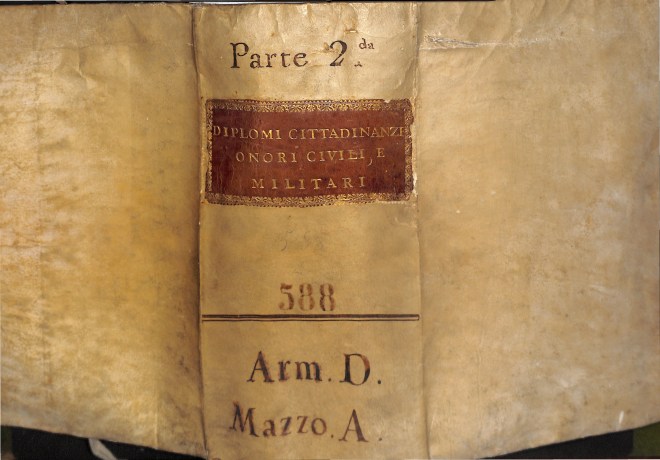
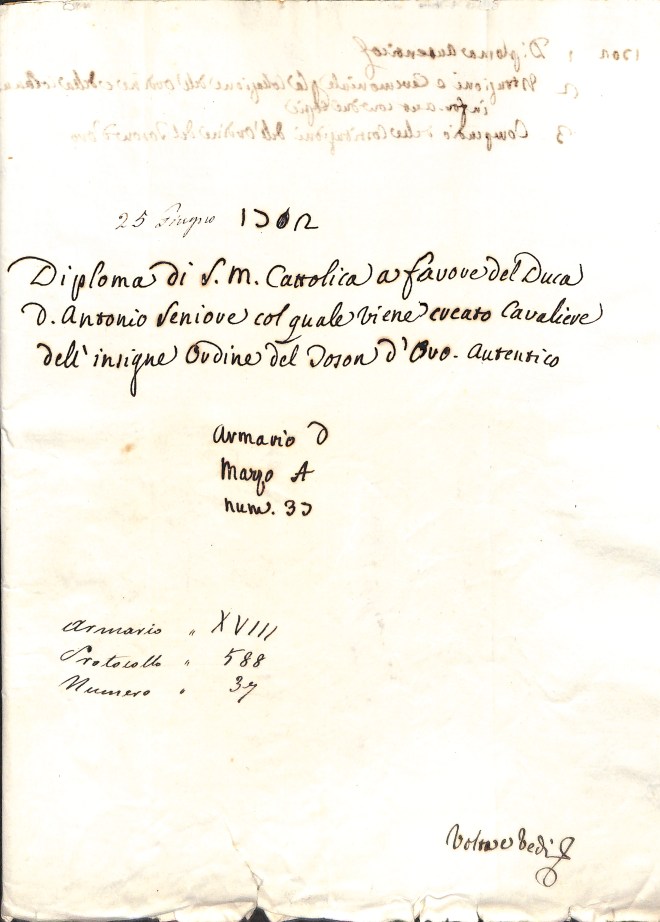
Our interest here is in the second installment in this series of honorary diplomas (= Protocollo 588), which runs from the years 1578 to 1734. Toward the end of this sequence one finds a thick packet (no. 37) dated to 25 June 1702, entitled “Diploma di S. M. Cattolica a favore del Duca d. Antonio Seniore col quale viene creato Cavaliere dell’insigne Ordine del Toson d’Oro”.

Archival wrapper (revised in XIX cent.) for Archivio Boncompagni Ludovisi Prot. 588 No. 37. Credit: HSH Prince Nicolò and HSH Princess Rita Boncompagni Ludovisi Archive, Villa Aurora, Rome

In other words, it is the case of a diploma issued by 18 year old King Philip V of Spain (reigned 1700-1746, with a brief hiatus in 1724). The recipient of the diploma is the Prince of Piombino, Antonio Boncompagni (1658-1676-1721). And the honor? Induction as a Knight into the celebrated Order of the Golden Fleece, a Roman Catholic order of chivalry that dates back to 1430, the year of its foundation in Bruges by the Burgundian duke Philip III (“the Good”). And as one would suppose, receipt of the Order’s distinctive symbol, a dazzling jeweled collar with pendant representing the Fleece.

Golden Fleece chain (15th century) by Bruges goldsmith and jeweler Jean Peutin, one of 24 he created for the first Knights of the Order. Credit: Artstor Collections

To be sure, the original copy of the diploma is found first in the dossier. In the same archival folder are three other items, clearly associated with the same occasion, and each—one imagines—meant to be confidential, at least in principle. First, detailed instructions on how to conduct the ceremony by which a Knight enters into the Order of the Golden Fleece, in Spanish (with careful Italian translation), dated to Madrid, 17 March 1694. These documents explicitly were drafted for the induction of Francesco Caracciolo (1668-1720), 5th Prince of Avellino. Second, another set of instructions in Spanish, closely modeled on the 1694 document, but specifically naming Antonio Boncompagni as the inductee. And third, in Italian, a history and “constitution” of the Order of the Golden Fleece, in 20 sections. There is a lot to unpack here, as they say. But in this post let us focus on that diploma signed by Philip V. [Read more…]