An illustrated essay by Carol Cofone (Rutgers ’17) with the collaboration of Nicholas Eimer (Rutgers ’24)

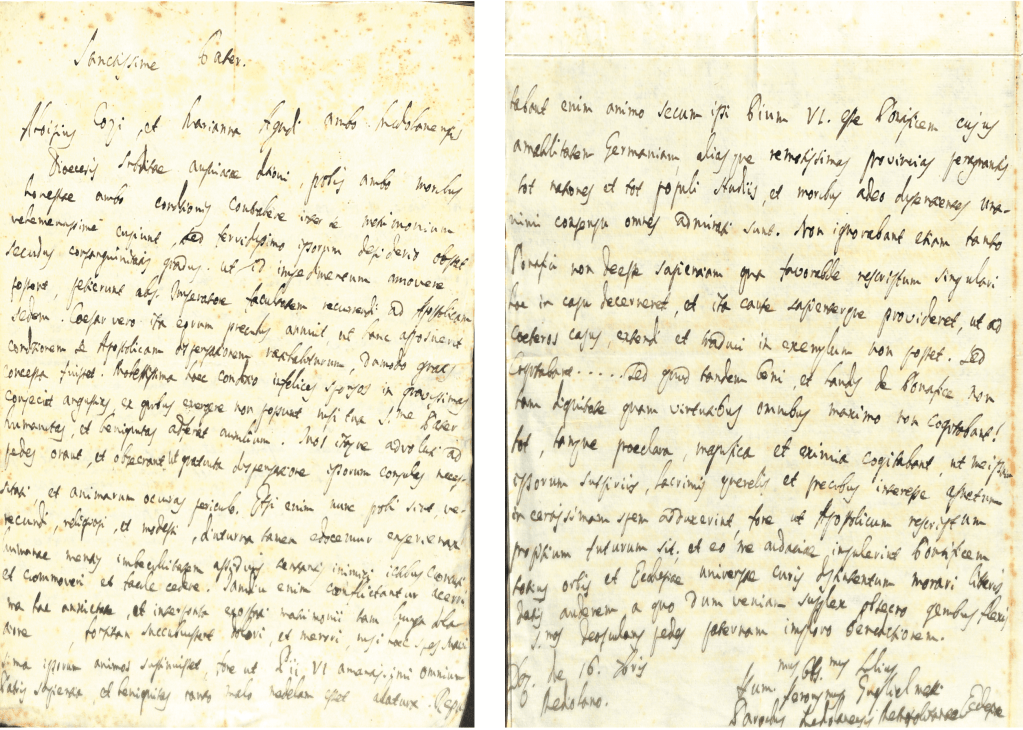
Among the tens of thousands of archival documents newly found in the Casino dell’Aurora in 2010 by HSH Princess Rita Boncompagni Ludovisi is an extraordinary Papal letter dated 4 July 1861. Unpublished and apparently unknown, it is written in Latin and signed by Pope Pius IX Mastai Ferretti (reigned 1846-1878). The letter is addressed to an illustrious group of ten Roman noblewomen. They include:
(1) Adélaïde Marie Hortense Françoise de La Rochefoucauld, Princess Borghese (1796-1877), the mother-in-law of Gwendoline (Guendalina) Talbot
(2) Marie Flore Pauline d’Arenberg Aldobrandini (1823-1861) [note date of death]
(3) Maria Carolina Ferdinanda Luisa Lucchesi-Palli, Princess of Arsoli (1798-1871) (born de Borbón-Dos Sicilias)
(4) Thérèse de La Rochefoucauld, Princess Borghese (1823-1894), the second wife of Marcantonio Borghese (1843), after Gwendoline Talbot
(5) Antoinette zu Sayn-Wittgenstein-Sayn, Princess of Campagnano (1839-1918) wife of Mario Chigi della Rovere Albani (1832-1914)
(6) Teresa Altieri Patrizi (1835-1887), the daughter of Clemente Altieri and Vittoria Boncompagni Ludovisi, wife of Marchese Francesco Patrizi Naro Montoro
(7) Rosalie Eustace, Marchesa Ricci-Paracciani (?-1909), the daughter of Lt. General Henry Eustace, wife of Marchese Giovanni Ricci-Paracciani
(8) Agnese Borghese Boncompagni Ludovisi, Duchess of Sora (1836-1920), daughter of Gwendoline (Guendalina) Talbot, and wife of Rodolfo Boncompagni Ludovisi
(9) Béatrice Archinto Altieri, Princess of Viano (1823-1890), wife of Emilio Altieri
(10) Arabella de Fitz-James, Duchess Salviati (1827-1903), wife of Scipione Salviati
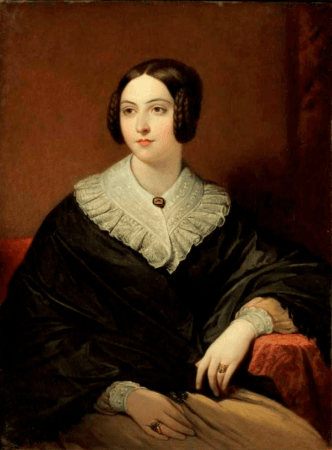
Particularly notable among them is Agnese Borghese Boncompagni Ludovisi, the daughter of Guendalina Talbot Borghese (1817-1840). Guendalina, though long deceased by the time Pius IX issued his letter, was a central figure among this group of women and a role model for her charitable works. The circumstances of her death raised her to the status of an unofficial saint in Rome.
Agnese is also the mother of Ugo Boncompagni Ludovisi (1856-1935), who recounts the details of his grandmother Guendalina’s passing in his 1921 memoir Ricordi di mia madre (recently translated into English by the author and soon to be published):
The duties of wife and mother did not prevent Princess Guendalina from giving herself entirely to the works of the most sublime charity. The consequences of the cholera that had troubled Rome in 1835 prompted her pious activity: this great lady, dressed simply, began to walk the streets of our city going from house to house, visiting, comforting, subsidizing the poor and sick in every way; so that just her making an appearance was blessed by the people...
In October 1840…my Grandmother, gripped by a serious sore throat, was confined to bed…
My mother was four and a half years old, and she could not in any way realize the misfortune that was going to befall her…My Grandmother flew to heaven on the 27th of October. The funeral procession of her body through Rome from the Palace to the Borghese Chapel in Santa Maria Maggiore was one of the most crowded events of that time.
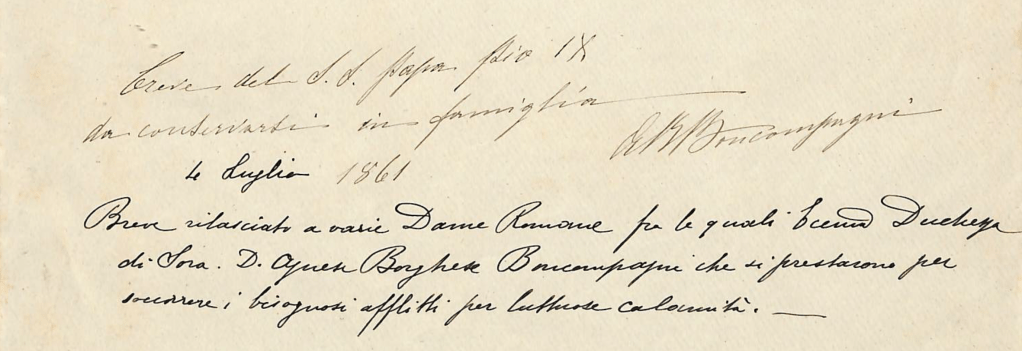
An archival notation—written on an accompanying envelope, below Agnese’s note directing that the letter was to be saved by the family—gives a clue to our Papal letter’s content:
Brief official response to various Roman noblewomen, including Princess Duchess of Sora, Agnese Borghese Boncompagni, who volunteered to provide for the material needs of those afflicted by the grievous calamities.
Indeed, the Pope’s letter is an acknowledgement of the efforts of this group, which undertook a lottery at his behest. The prizes were gifts previously given to the Pope; he in turn donated them to this charitable cause, as he was wont to do.
One does not have to look far for other instances of Pius’ re-gifting presents. Indeed a few months after this letter, in October 1861, The Tablet (a British Catholic weekly, still published) printed an account that details Pius’ donation to the Immaculate Conception Charity, and offers the Pope’s own rationale for the practice. “When informed of our twenty thousand neglected children, the Holy Father turned to a beautiful painting on porcelain of the Sacred Heart of our Lord and the Immaculate Heart of Our Lady, which stood on his table in a rich frame, surmounted by the Papal arms and said ‘This has been a comfort to me in my trouble—it is a gift to me—but now I have nothing left to give except what is given to me. Let this go to the Orphans of London.”

The Pope’s letter to the Roman noblewoman makes clear that the Pope had donated several gifts, which were offered through a lottery, the cause of which was to help the aforementioned “afflicted”. The letter’s full transcription (by Nicholas Eimer) and translation are as follows:
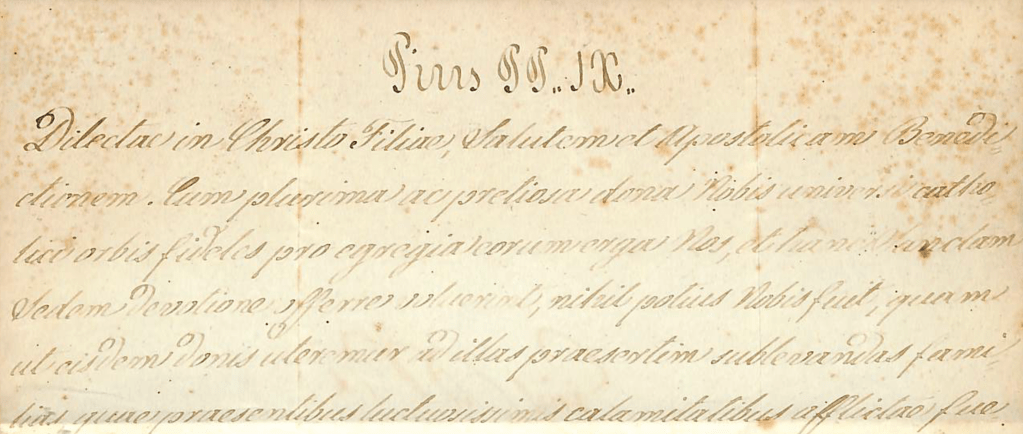
Pius IX
Dilectae in Christo filiae salutem et Apostolicam Benedictionem.
Cum plurima ac pretiosa dona Nobis universi catholici orbis fideles pro egregia eorum erga Nos, et hanc Sanctam sedem devotione offerre voluerint, nihil potius Nobis fuit, quam ut eisdem donis uteremur ad illas praesertim sublevandas familias, quae praesentibus luctuosissimis calamitatibus afflictae fuerunt.
Quocirca aleatoriam eorumdem donorum sortitionem statuendam, ejusque curam Vobis, Dilectae in Christo Filiae, omnino committendam esse existimavimus.
Certi enim eramus, Vos generis nobilitate, virtutis, religionis, pietatisque laude, et christianae caritatis studio praestantes, ac Nobis et huic Petri Cathedrae ex animo addictas hujusmodi rem libentissime esse peracturas, Nostrisque votis quam cumulatissime satisfacturas.
Atque ita evenit. Namque singulari prorsus cura, industria, diligentia vestram omnem operam in eadem sortitione conficienda impendistis; nihilque intentatum reliquistis, quo hujusmo de sortito optatum assequeretur exitum, veluti luculenter apparet ex ratione, quam Nobis per litteras pridie kalendas hujus mensis conscriptas reddere properastis.
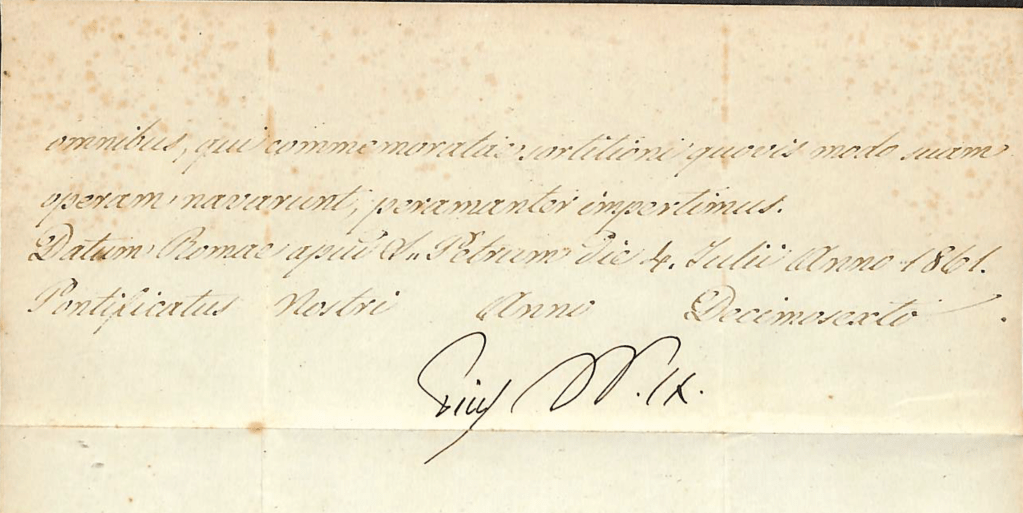
Itaque alacri libentique animo has litteras ad Vos damus, quibus et debitas Vobis agimus gratias ac meritas amplissimasque tribuimus laudes pro eximia saneque re (?) quam Nobis in hac re iuxta Nostra desideria dedistis.
Pro certo autem habeatis velimus, praecipuam esse, qua Vos prosequimur, benevolentiam. Cujus quoque certissimum pignus accipite Apostolicam Benedictionem, quam ex intimo corde profectam, et cum omnis verae felicitatis voto conjunctam Vobis ipsis, Dilectae in Christo Filiae, vestrisque Nobilibus Familiis, et aliis omnibus, qui commemoratae sortitioni quovis modo suam Operam navarunt, peramanter impertimus.
Datum Romae apud S. Petrum die 4. Julii Anno 1861. Pontificatus Nostri Anno Decimosexto
Pius IX
[Recipients:]
Dilectis in Christo Filiabus Nobilibus Feminis
Adelaidi La Rochefoucauld Borghese
Mariae Aremberg Aldobrandini
Franciscae Lucchesi Palli Princip.
Avsoli T. La Rochefoucauld Princip. Borghese
Wittgenstein Princip. Campagnano
Theresiae Altieri Patrizi
Rosalinae Enstace March. Ricci
Agneti Borghese Boncompagni Duci Sorae
Beatrici Archinta Altieri Princip. Viano et
Arabellae De Fitz-James Duci Salviati
TRANSLATION:
Beloved daughters in Christ—greeting and Apostolic blessing.
Though the faithful of the entire Catholic world has been willing to offer us many precious gifts on behalf of their outstanding devotion to us and this Holy See, there was nothing that we preferred, than to use these very gifts especially to alleviate those families who have been afflicted by the present extremely grievous calamities.
For this reason, we thought that we ought to establish a random lottery of these same gifts, and that we thought that its care should be entirely delegated to you, our beloved Daughters in Christ.
For we were certain, that you—outstanding in the nobility of family, virtue, religion, piety, and zeal for Christian charity, and passionately devoted to us and this Chair of Peter, most willingly would accomplish a project of this type, and that you would satisfy our wishes as fully as possible.
And so it has turned out.
For you spent all your efforts in accomplishing this same lottery, with singular care, industry, and diligence; and you have left nothing untried, so as to obtain the desired result from this lottery, as it appears clearly from the account which you hastened to render to us in a letter written on the eve of the first day of this month [i.e., 30 June 1861].
And so we give this letter to you with a hearty and cheerful spirit, in which we both offer the thanks due to you, and give you the most deserved and fulsome praises for the extraordinary and truly remarkable achievement (?) which you have given to us in this matter according to our desires.
But we want to assure you that the chief thing with which we honor you is goodwill. As also a most certain pledge of this, receive the Apostolic Blessing, which, proceeding from my innermost heart, and joined by a wish for all true happiness, for you yourselves, beloved Daughters in Christ, and for your Noble Families, and for all the others who, have in any way devoted their attention to the aforementioned lottery, we lovingly impart.
On the face of it, this letter would seem to be a polite acknowledgement of the philanthropic efforts of a dedicated group of elite church members and papal supporters. But the family archivist’s notation, and the words of Pius IX himself, alert us to how political events prior to 1861 shaped the perceptions of the Pope and the noble class that supported him, and thus the lives of these noblewomen.
The beneficiaries of this lottery, referred to in the Pope’s letter as families who have been afflicted by the present extremely grievous calamities, which is echoed in the archivist’s notation as “those afflicted by grievous calamities,” might seem to us modern readers as victims of a natural disaster. But a closer reading suggests otherwise.
A comparison with some of the other writings of Pius IX suggests an alternate connotation to the word calamities. The Latin phrase luctuosissimis calamitatibus was a common usage of the Pope’s speech writer, always rather vague but always apparently in reference to metaphorical calamities, especially theological and political. Often calamitates is joined with perturbationes, i.e., any shaking of the established order especially as it pertained to the Catholic establishment itself.
Thus there is a case to be make that the calamities Pius IX referred to in his letter to Agnese and her circle were the ones that grievously afflicted him first of all. It may be that the phrase referred to the events leading up to unification – in particular, to the campaign of Giuseppe Garibaldi and the Expedition of the Thousand, which lasted from April through July in 1860:
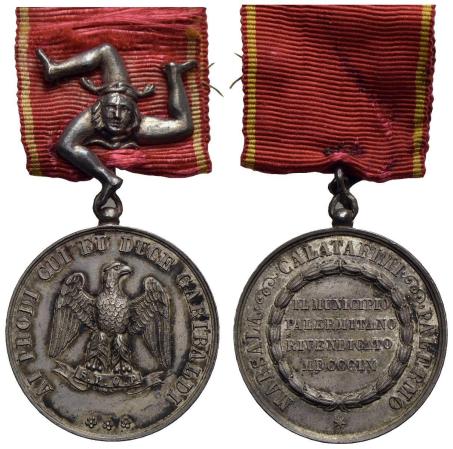
This brief account establishes a frame of reference.
A revolt in Sicily, beginning on 4 April 1860, caused Garibaldi to make the decision to begin with an attack on the Bourbon kingdom in the south. On the night of 5-6 May, he embarked from Quarto (a suburb of Genoa) with more than 1,000 men, mostly idealistic young northerners. Narrowly missing contact with the Bourbon Navy, the expedition landed at the western Sicilian port of Marsala on 11 May.
Garibaldi was faced with the problem of defeating more than 20,000 Neapolitan troops of the Bourbon King Francesco II in Sicily with an untrained force armed only with rusty rifles. After proclaiming himself dictator of Sicily in the name of Vittorio Emanuele II, he led his men across the island toward Palermo. He defeated a Neapolitan force at Calatafimi (15 May), and many Sicilians then joined him to help overthrow their hated Neapolitan rulers. Aided also by the incompetence of the Bourbon command, Garibaldi captured Palermo (6 June) and, with the Battle of Milazzo (20 July), won control of all Sicily except Messina.
Italian literature, specifically the short story “Bronte” published on 12 March 1882 in the magazine Literary Sunday by writer, playwright and Italian senator Giovanni Verga (1840-1922), offered a riveting version of what took place in August 1860 in the small town of Bronte in Sicily. He tells how the peasants in Bronte, having heard that Garibaldi was coming to free them, took it upon themselves to slaughter members of the elites who had authoritative roles in the town. When Garibaldi’s general arrived, he ordered that those murdering peasants be shot.
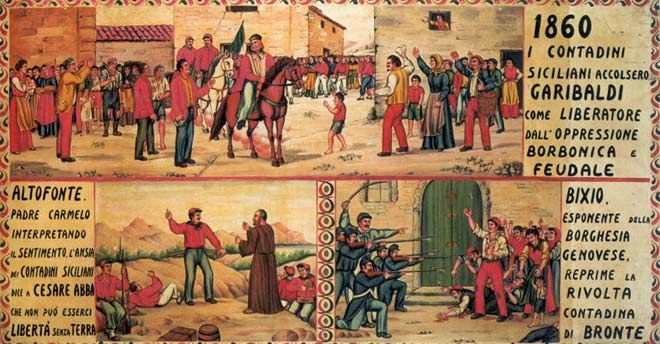
Thus, it may well be that Pius’s object in aiding those afflicted by the present extremely grievous calamities was to aid the more elite families caught up in the vicissitudes and violence occasioned by the unification of Italy. The lottery may have sought to help those kinds of families that previously had higher status, that were now being pressured by unification, not too unlike the noble papal families themselves. Agnese and her mother’s circle may well have been taking care of their own.
In fact, Pius himself was one of the first so afflicted. Early in the pages of Ricordi di mia madre, Ugo Boncompagni Ludovisi gives us a list of some early grievous calamities—the political events of 1848 that drove Pius IX from Rome to Gaeta for his own safety.

Meanwhile, the assassination of [Pellegrino] Rossi [†15 November 1848], the behavior of the people and of the troops themselves who demonstrated on the 16th [i.e., of November 1848] at the Quirinale—which caused [Luigi Carlo] Farini to exclaim with grief: “the assassination and revolt celebrated as a triumph!”—the ministry that [Giuseppe] Galletti forced on the Pope, the Costituente Romana that was nearly forced on him, the manifesto of the new Government, even more the vote of the Chamber recorded in the session of the 20th [i.e., of November 1848]: all these things cause the Pope to leave Rome and, between the 24th and 25th, dressed as a simple priest, accompanied by Count Spaur, minister of Bavaria, and the Countess, who was Roman, Pius IX left.
Agnese, then a 12-year-old girl wrote of these events in her own diary. In Ricordi di mia madre we read her account of what happened when her family followed him there, with Ugo’s annotations in brackets:
Saturday, the 25th of November [1848].
Papa received the news of the Pope’s departure when I was having a history lesson; as he wanted to hide our departure from my teacher, I did not know until ten o’clock that they asked the teacher to wind the lesson up [the teacher, a very educated man that I knew well, held other political ideas, but it is clear that my Grandfather did not want to let him learn the serious event of the night before]. Maria [Maria Calamassi, the nanny and an excellent person from Tuscany; I knew her well too. With the exception of my Mother, all that generation of the Borghese had passed through her hands; she was the wife of my Grandfather’s faithful butler] had already left with the four children [Anna Maria later Marchesa Gerini, Paolo Prince Borghese, Francesco Duca di Bomarzo and Giulio later Prince Torlonia]. We [that is, Princess Teresa (i.e., de La Rochefoucauld) and my Mother] climbed into a carriage with my Grandmother and Aunt [the Duchess Arabella Salviati, born Fitz-James] and without bringing anything, we left via the Porta del Popolo. Then by the Villa [Villa Borghese] we met Papa and my Uncle [the Duke Don Scipione Salviati] near the vineyards where the children were. At Tor di Mezza Via [the first postal station on the Via Appia] we changed horses. [I remember that my Mother told me many times that my Grandfather had to resort to a little trickery to get these horses, because postal horses were not for the use of a private individual without a special permit: although no such permit was shown at the first post; nor at the successive ones, where the postmaster assumed we had one, they let us continue undisturbed]. Papà and my Uncle were seated on the coach box, and so all of us sadly continued on our journey. What tormented us most was not knowing where the Pope was…

“Sunday, the 26th [of November 1848].
“This morning we got up early and had breakfast with my Uncle Doria [Prince Filippo Doria, husband of the other Talbot sister, Lady Mary, and therefore my mother’s uncle and my grandfather’s brother-in-law. Let me remind you that my Grandfather, about to leave, had cautiously warned him] who arrived two hours after us and was obliged to sleep on a chair, finding nothing else. All together, we said prayers, most fervently for the Pope and for Rome that perhaps at this moment was in the hands of the demonstrators. We had no passports, but Count [Giacomo] Antonelli was able to let us pass, and so we arrived in Fondi [the first city of the Kingdom of Naples] to hear Mass. What a pleasure it was for us to stop there! We found a number of people gathered in the square, and when Papà asked why, they replied that the Pope had passed through. He had stopped there and left a few hours before. His nephew [I think he was Count Luigi Mastai, son of the Count Gabriel, firstborn of that family] was still there; he confirmed the news and told us that the Pope had gone to Gaeta. We then went to Mass, which was in thanksgiving for us to have, without knowing it, followed the Pope. The Doria family was, like us, delighted by this news, and immediately we all left for Gaeta; it seemed that the displeasure of having left Rome had been replaced by the pleasure of meeting up with the Pope…
“As soon as we arrived in Gaeta, Papà went to the Pope who was still at the Giardinetto Inn, and he seemed very happy to see that he was not abandoned by everyone.”
These details shed light on the family’s experience as a social and political class under siege. It is telling that three of the women involved in the enterprise of the Pope’s lottery in 1860 were involved in this flight to safety in November 1848. They themselves were afflicted by these grievous calamities, and later calamities that followed.
Ugo’s telling of how his parents responded to the events of 1860 shows their continuing loyalty to the Pope:
In the summer of 1860 we were in Paris and at the baths of Sainte-Adresse, three kilometers from Le Havre. I remember understanding that political events caused our return to Rome. (François XIV) De La Rochefoucauld, who was already appointed when he was in Rome and who was now in French diplomacy, came one morning to Paris to my Mother—while the occupation of le Marche and Umbria was underway—and he briefly mentioned serious political events in Italy. He suggested that, if they wanted to return to Rome without difficulty, they leave immediately. We left, we went – it was then the quickest way – by sea from Marseilles to Civitavecchia…Though newspapers and news from Rome announced the entry of Garibaldi’s troops into the small remnant of the Papal State, my family did not want to be far away.
Perhaps this firsthand experience reinforced their commitment to their charitable undertakings in 1860—and those that followed later—through which they strove to take care of their own.
To understand this definition of who was “their own” we return once again to Ugo’s Ricordi di mia madre.
He writes of another class of individuals who were afflicted by these calamitous events: the Papal Zouaves. They were a corps of volunteers formed as part of the Army of the Papal States. They were young, unmarried, Roman Catholic men, who volunteered to assist Pope Pius IX in his struggle against the Italian Risorgimento. The Papal Zouaves assisted in the notable Franco/Papal victory at the Battle of Mentana on 3 November 1867, where the sustaining 81 casualties in the battle, including 24 killed.

Ugo gives us greater insight into the Battle of Mentana via his account of a conversation between his mother Agnese and Zouave commander Baron Athanase Charles Marie de Charette, and reinforces another connection to the noblewomen engaged in the Pope’s philanthropy.
At the end of November of that year, some people took part in a battle at Mentana. The then Lieutenant Colonel of the Zouaves, Baron de Charette, who had led the regiment in the attack, was in the group and explained the stages of the action; The regiment swept through Via Nomentana, passed the Capobianco crossroads and continued for three or four kilometers. There, he said, the fight had begun. My mother then asked him what a soldier felt in that instant, and de Charette immediately replied with sincerity and military roughness: “One is afraid, and whoever tells you otherwise, is lying; then slowly things change, there is a state of almost intoxication that makes everyone forget, but, again, at the beginning one is afraid.”…de Charette had a soldier’s soul…His first wife was a Fitz-James, sister of my mother’s aunt, Duchess Arabella Salviati, already mentioned here several times.
These afflicted soldiers drew the attention of the Boncompagni Ludovisi family and Agnese’s circle of noblewomen in 1867. As Ugo explains,
It is well known that papal soldiers wounded during the campaign in Rome (which then took its name from Mentana) were treated with great Christian charity. Wounded Garibaldini, who were much more numerous, were also treated with no less kindness. My father was a regular in those hospitals, especially in the one open near Sant’ Agata de’ Goti; and it was there, it seems to me, that he knew, or at least strengthened his relationship with Count (Emanuele) De Bianchi, a distinguished gentleman from Bologna, who became his collaborator in the work I will now discuss…
In Rome, where even the Pontiffs had always taken care, in their numerous demonstrations, to assist all the miseries of our poor humanity, there was no institute for the education of blind children…
Ugo goes on to describe how Pius IX appointed a commission to provide for the needs of the blind,
composed of my Father (Rodolfo Boncompagni Ludovisi), who was President; Father (Bernardino Secondo) Sandrini, General of the Somaschi; Count Emanuele De Bianchi—Vice President; Marquis Girolamo Cavalletti—Treasurer; Dr. Vincenzo Diorio; and the accountant Filippo Giangiacomo—Secretary.

But then he describes how “the Lord” provided for the actual work to be done:
Alongside this commission, Our Lord provided others, of whom my Mother was the soul. Besides my Mother, there were the Princesses Odescalchi, Rospigliosi, Lancellotti di Sarsina and Sulmona and the Marquises Cavalletti Heron and Ricci…It was necessary to begin the formation of a foundation to provide for minor set-up costs during the first year of life of the nascent Institute. Rightly the institute did not want to rely on the munificence of the Pope for everything and so considered holding a great lottery. But the Princess Rospigliosi (born de Nompère de Champagny) who was no less full of ideas than my Mother, proposed a Charity Bazaar…The idea was accepted, and the number of Ladies and Gentlemen who wished to contribute to the success of the event grew.
Ugo goes on to share the details of how this incredible matriarchal charitable machine, built upon its noble foundations, expanded its mission in the year 1869. Their efforts may well have served as a model for other charitable groups who undertook charity bazaars throughout Europe in the following years. Inspired by Guendalina and masterminded by Agnese, whose experience in supporting the Pope and responding to calamities dated back to 1848, it was a formula for success:
I remember that they gathered again and again in my Mother’s salons at the Villa Ludovisi. So many gave so much effort to this charity fair. I have the dates of these meetings, so close to each other, that they tell us with how much feverish activity they proceeded. The meetings were held on the 14th, 17th, 19th and 22nd of January [i.e., 1869]. The day chosen for the fair was the Friday of Carnevale, February 5th: the day the so-called Corso was being held.
In addition to the above mentioned ladies, Princess Pallavicini, the Duchess of Fiano, my father’s two sisters [i.e., Maria Carolina and Giulia Boncompagni Ludovisi], and then Donna Matilde Lante, the Countess of Cellere neé Capranica, the Princess of Campagnano, the Princess of Teano, the Countess Lutzof, the Marchesa Clotilde Vitelleschi, Princess Barberini, Duchess Torlonia, the Duchess of Gallese, Marchesa Sacchetti, Duchess Salviati, Countess Bracceschi, Marchesa Marini, Princess of Scilla, Contessa Bruschi, Baroness Kanzler, Marchesa Serlupi, the Princess Giustiniani-Bandini and the Princess of Viano were also recruited.
The gentlemen added to the Commission were the Marquis Guido Bourbon del Monte, Don Mario and Don Giulio Grazioli, Don Baldassarre Odescalchi, the Baron de Charette, the Prince of Sulmona, the Prince of Sarsina, the Marquis Maurizio Cavalletti.
The work entrusted to such a select group of people could not fail to be fully successful. The Town Hall granted the beautiful rooms of the Palazzo dei Conservatori; the best military concert, that of the Gendarmes, an excellent concert of that time, apparently played in the courtyard. The stalls for sale evidently were prepared by the Institute Commission; the newly recruited ladies in particular were given the task of selling the tickets; everyone was tasked with getting items from the best artists and shopkeepers for the sale itself.
In the Sala degli Orazi, at the foot of the statue of Urban VIII by Bernini, was the bench with the gifts of the Pope: watched over by the Odescalchi and Rospigliosi Princesses; at the foot of the other statue, that of Innocent X, was a great kiosk of flowers entrusted to the Princesses Giustiniani-Bandini, Scilla and Donna Matilde Lante. At the entrance of the Sala dei Capitani, I still see it, at a counter that would remind you of a window at a post office, was the Princess Pallavicini. Thanks to all her connections, that window was always crowded, and those who asked if there were letters addressed to them received in elegant envelopes a witticism, a proverb, some bits of verse: all this, well I remember, had been carefully prepared by my Mother. The highly educated Countess Desbassains de Richemond presided over the fine arts; the Princesses of Viano and the Marquise Marini, the knick knacks; the Baroness Kanzler, the party favors; the Princess Barberini and the Countess Lucernari, the sacred objects; the Countess of Campello, the toys and the Roman pearls. A grab bag, a kind of surprise package, was held by the Marchese Cavalletti Herron. In the Sala dei Capitani, the one with the statues that recall Marcantonio Colonna, Alessandro Farnese and other great names, the crowd gathered at the pastry counter entrusted to Princess Windisch-Gratz, the Duchess of Fiano and the Countess of Cellere; an even denser crowd crammed around the great tea table where the Duchess Salviati, the Princesses of Sulmona and Rospigliosi and the Contessas Bracceschi and La Ferronays were.
The Piazza del Campidoglio could not contain the carriages, so they were forced to wait in the Piazza d’Aracoeli below. The great halls gathered in those four hours—because the Bazaar opened at one and closed at five pm—as much as the aristocratic and elegant world, both Italian and foreign, could lavish, all attracted by the nobility of the gentlemen, by the dignity of the environment, by the novelty of the party. I still see that large, courtly crowd, happy!
The financial result could not be more flattering. Note that Rome had then little more than two hundred thousand inhabitants, that the value of money, both absolute and relative, was many times superior to the present. By 5:00 pm, 20,667.64 Lire had been collected; moreover, an account had given an annuity of 50 Lire and some of the gifts offered by the Pope were still unsold. The expenses were relatively minimal: the objects purchased for sale came to 3,729 Lire, the decorations 680 Lire, printing, gratuities and other things 165.70 Lire; so, besides the annuity and the objects given by the Holy Father, by 5 o’clock the net was a good 16,092.94 Lire. About two thirds of this sum was reinvested and went to form the principle of that foundation of the ophthalmic Institute, which today normally welcomes more than forty blind boys and girls.
I do not think it is wrong to state that the most majority of the credit for that happy success went to my Mother; I remember very well the day that I spent, a happy boy, in all those majestic, crowded, elegant rooms. I had sketchy memories of those figures. I still had the names in my head of many of those ladies; but now I wanted and have been able to clarify and do justice to these memories. Although the event itself is small, it is at the beginning of the foundation of that Institute, which has, as I said, assumed so much importance; and I kept reminding myself that this work of true charity owes no small part of its beginnings to my parents.

By 1870, Pius IX had become the self-proclaimed “Prisoner of the Vatican”. By 1886, the Boncompagni Ludovisi had subdivided and sold most of the Villa Ludovisi. By 1889, the commune of Rome had expropriated their Palazzo Piombino newly constructed on Via Veneto. Clearly the political and social forces leveled against the elite class of noble Papal families was marginalizing them.
For that reason, Agnese Borghese Boncompagni Ludovisi stands today as a model of how a noble family’s values were preserved across generations, despite “extremely grievous calamities.” Agnese and her fellow Roman noblewomen, at the Pope’s bidding, did very successfully provide for their own. But over time, they redefined “their own” as a larger, more inclusive group, and championed them on an even grander scale.
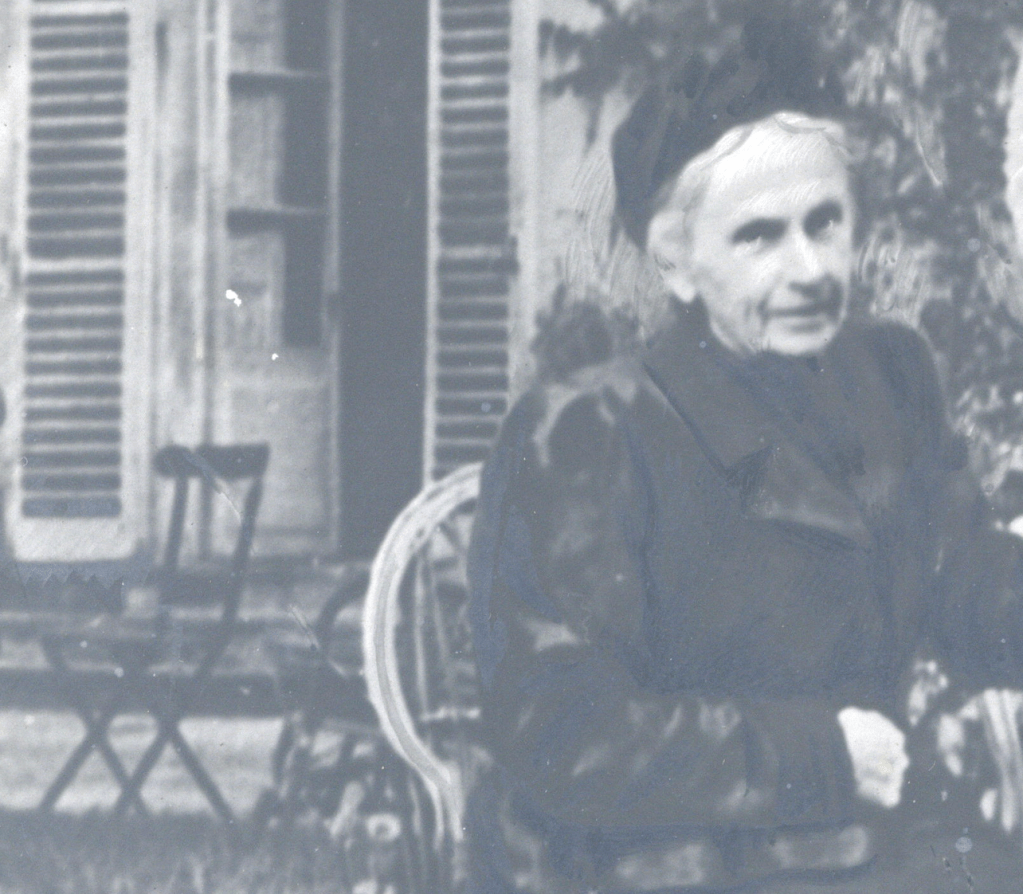
Carol Cofone, Assistant Director of the Archivio Digitale Boncompagni Ludovisi, has been associated with the project since 2014. She is a 2017 graduate of Rutgers, with a degree in Italian and a certificate in Historic Preservation. She is grateful to HSH Princess Rita Boncompagni Ludovisi for providing access to her private archive, and for her encouragement. She thanks Nicholas Eimer (Rutgers Honors College ’24) for his careful transcription of the Pius IX letter, and Professor T. Corey Brennan for his invaluable guidance and support.


 Archivio Digitale Boncompagni Ludovisi