By Alexis Latterman (Kutztown University ’25)

The Boncompagni Ludovisi—Brandolini d’Adda wedding party at the Casino dell’Aurora, afternoon of 11 June 1925 (colorized). Collection of HSH Princess Rita Boncompagni Ludovisi, Rome
On Thursday 11 June 1925, Princess Laura Boncompagni Ludovisi, aged just 16, married Count Annibale Brandolini d’Adda at her family’s church of S Ignazio in Rome. The groom was ten years her senior. Their church wedding followed one day upon a civil service on Rome’s Campidoglio.

Wednesday 10 June 1925: Count Annibale Brandolini d’Adda and Princess Laura Boncompagni Ludovisi depart from the Campidoglio after their civil wedding, to be followed by a ceremony in S Ignazio the next day. Collection of HSH Princess Rita Boncompagni Ludovisi, Rome
Precisely how the couple met is uncertain, but the power and status of the two families is not. And with a photo album in the Archivio Boncompagni Ludovisi in the Casino dell’Aurora containing many dozens of images connected to their wedding, and newspaper clippings saved by Laura Boncompagni Ludovisi herself, we can gather a clear sense of what the special day consisted of.
The Brandolini family was an old noble family of north Italy with origins in medieval Forlì and Bagnacavallo (both Emilia-Romagna), that rose to prominence through their military services in the fourteenth and fifteenth centuries to the Republic of Venice. From 1439 they held the title of Counts of Valmareno, in the area of Treviso in Veneto. In 1868, the groom’s grandfather (also named Annibale) had married Leopolda d’Adda di Pandino, which is how the Brandolini acquired the additional surname. This Leopolda was a distant relative of the Marchesi d’Adda Salvaterra, ancestors of Laura Boncompagni Ludovisi through her mother’s maternal line.
So the bride and groom of 1925 had a remote family relationship. Yet there is no real evidence of a connection between the two families before this marriage. For example, the inventory of the Archivio Boncompagni Ludovisi in the Vatican Apostolic Archive contains no correspondence with the Brandolini d’Adda. It is possible that the bride’s father, Francesco Boncompagni Ludovisi, met the Brandolini d’Adda through World War I service, since he spent most of the years 1915-1918 as an officer in the Veneto region. The Brandolini d’Adda fought with great distinction in that conflict. Indeed, the bridegroom’s uncle, Count Brandolino Brandolini d’Adda, was the only member of Italy’s Chamber of Deputies to be killed in action during the war.

Spring 1925: Nicoletta Boncompagni Ludovisi (born Prinetti Castelletti) and her newly engaged daughter Laura. Collection of HSH Princess Rita Boncompagni Ludovisi, Rome
Laura Boncompagni Ludovisi (born 29 November 1908) was the eldest of the four children of Francesco Boncompagni Ludovisi and Nicoletta Prinetti Castelletti, since 1911 Prince and Princess of Piombino, and residing in the Casino dell’Aurora in Rome. In a scrapbook, Princess Laura saved a newspaper clipping from Il Tevere, a recently founded Fascist newspaper, that describes the wedding in extreme detail, as well as numerous images from the wedding. None of the photos from this set seem ever to have been published. In contrast, seven years later to the day (11 June 1932), when Laura’s younger sister Giulia Boncompagni Ludovisi married her cousin Giovanni Boncompagni Ludovisi Rondinelli Vitelli, L.U.C.E. photographers were on hand to record the event in detail.

Clipping (detail) from Il Tevere, 12 June 1925. Collection of HSH Princess Rita Boncompagni Ludovisi, Rome
The Il Tevere account of Princess Laura’s wedding (published 12 June 1925) is worth offering in full, not least since it gives us significant insight into the contemporary political connections of Francesco Boncompagni Ludovisi, three years before Benito Mussolini named him as governor of Rome, a post he then held for seven eventful years (1928-1935). (For a full discussion of his later anti-Fascist activities, see here.)
The Newlyweds. Yesterday morning, the wedding of Lady Laura Boncompagni Ludovisi to His Excellency Count Brandolin d’Adda was celebrated in the austere church of S. Ignazio. The magnificent temple was beautifully adorned with plants, lilies, and roses. The noble coats of arms of the Boncompagni family were displayed on the walls of the main altar, and the red brocades, carpets, and armchairs donated lent an air of grand austerity.
On either side of the altar were arranged armchairs where the relatives of the newlyweds took their seats. In the center of the church, almost beneath the dome, were the chairs for the bride and groom and their witnesses, and behind them were seats for the numerous guests. The rest of the church was occupied by a large crowd of people who stood behind the benches, through which the bridal procession passed.
At 9:30 AM, the guests began to arrive, and shortly before that, the square of Sant’ Ignazio and its surroundings had been cordoned off by the National Militia to prevent crowds from gathering in front of the church. At 10:00 AM, the authorities started to arrive: His Excellency Benito Mussolini, Commander Chiavolini, His Excellency Federzoni, Honorable Acerbo, His Excellency Rocco, Honorable Martire, Honorable Grandi, etc.
Shortly thereafter, in a white gown adorned with precious lace and orange blossoms and with a long train, the lovely and very young bride arrived, escorted by her father, Prince Don Francesco Boncompagni.
The bride’s long train was held not only by her younger brother, Alberigo Boncompagni Ludovisi, but also by the charming Valeria Federzoni and the equally charming Rita Guglielmi.
Following the bride’s entrance, her mother, Lady Nicoletta of Piombino, very elegant in a strawberry-red gown, and other relatives of the bride followed. Balilla boys with their respective banners formed a guard of honor as the bridal procession passed.
The groom, accompanied by his witnesses, awaited the bridal procession at the altar: His Excellency Benito Mussolini, Prince Boncompagni, Count Lucchesi-Palli, and Admiral Mario Casanova.
As the bride entered, an orchestra of strings, accompanied by the organ played by Maestro Cav. Giuseppe Prato, performed Mendelssohn’s “Wedding March.”
His Eminence Cardinal Vincenzo Vannutelli, Bishop of Ostia and Dean of the Sacred College, arrived at the altar accompanied by Jesuit scholars.
Assisted by Rev. Father Pietro Lalli, parish priest of S. Andrea delle Fratte and General of the Order of Minims, as well as by the ceremoniarius Monsignor Umberto Bertini.
The low Mass proceeded while the Schola Cantorum of San Salvatore in Lauro, along with the finest singers from Roman chapels, directed by Maestro Bonaventura Somma, performed Mozart’s “Ave Verum,” Perosi’s “Ora Pro Nobis,” and the “Canticle of Canticles.”
At the end of the Mass, His Eminence Cardinal Vannutelli delivered a brief congratulatory speech to the couple, emphasizing the sanctity of the family, which the newlyweds were expected to uphold, as they belonged to two noble lineages that had never wavered in their faith.
Then, His Eminence bestowed his blessing upon the newlyweds, and after the ceremony, the couple, accompanied by their distinguished witnesses, went to the nearby sacristy to formalize the marriage certificate.
A large crowd of guests had gathered to pay their respects to the young couple. Exceedingly elegant gentlemen and ladies, hailing from the most aristocratic families of Italy, formed a gathering of beauty and elegance rarely witnessed.
After the religious ceremony, the newlyweds proceeded to S. Pietro, and as the final notes of the organ and violins filled the air scented with the delicate fragrance of lilies and the solemn scent of incense, the bridal procession and guests slowly left the church.
A crowd of onlookers in the square cheered the newlyweds, and as the National Militia saluted Il Duce (Mussolini), a burst of applause and numerous cheers rang out in honor of the Head of Government.
Count and Countess Laura Brandolin d’Adda, after an intimate lunch with family, departed for an extended journey abroad, heading toward their long-awaited destination: happiness.

After the wedding ceremony at S Ignazio, the newlywed couple enter S Pietro for a papal blessing. Collection of HSH Princess Rita Boncompagni Ludovisi, Rome
The description of the wedding offers much scope for comment, since attending were numerous politically powerful people including Benito Mussolini himself. Here is a list of the people named in the Il Tevere account of the wedding, other than the bride and groom:
Officiating: Cardinal Vincenzo Vannutelli (1836-1930), Cardinal since 1890, now aged 88; Monsignor Umberto Bertini, ceremoniarius; Rev. Father Pietro Lalli (1882-1960), Corrector General of the order of the Minimi since 1924; Maestro Cav. Giuseppe Prato, organist; Maestro Bonaventura Somma (1893-1960), noted musician and composer; Jesuit scholars
Named family: Prince Francesco Boncompagni Ludovisi (1886-1955), father of the bride and witness, member of the Chamber of Deputies, since February 1923 president of the Banco di Roma; Princess Nicoletta Prinetti Castelletti (1891-1931), mother of the bride; Prince Alberico Boncompagni Ludovisi (1918-2005), younger brother of the bride.
Witnesses to the marriage: Francesco Boncompagni Ludovisi, father of the bride; Benito Mussolini (1883-1945), Prime Minister since 30 October 1922; Count Pietro Lucchesi-Palli (1870-1939), maternal uncle of the bridegroom; Mario Casanuova Jerserinch (1867-1949), retired naval admiral; uncle (by marriage) to the bridegroom.
Bridal party: Annalena [probably not ‘Valeria’] Federzoni (1920-), daughter of Luigi Federzoni and Luisa Melotti-Ferri; Marchesa Maria Rita Guglielmi (1918-)
Named guests: Alessandro Chiavolini (1889-1958, “Commander”), journalist and special secretary of Mussolini (1922-1934); Giacomo Acerbo (1888-1969), economist and politician, drafted the Acerbo Law (1924) that helped Mussolini’s Fascist Party gain a majority of seats in the Chamber of Deputies; Luigi Federzoni (1878-1967), Minister of the Interior; Aldredo Rocco (1875-1935), immediate past President of the Chamber of Deputies, then Minister of Justice and Worship Affairs; Egilberto Martire (1887-1952), founder and president of clerico-fascist group Fides Romana and member of Parliament for the (pro-Fascist) Centro Nazionale Italiano; Dino Grandi (1895-1988), militant fascist, then serving as Undersecretary of the Interior.
Not mentioned in the news report is the family of the groom: his parents, Girolamo Brandolini d’Adda (1870-1936) and Gabriele Lucchesi-Palli (1875-1937), or his younger siblings Maria (born 1900), Giovanni (1901) or Vendramima (1902) Brandolini d’Adda.

Leaving S Pietro after a blessing by Pope Pius XI. Collection of HSH Princess Rita Boncompagni Ludovisi, Rome
Nor does the article mention the festivities at the Casino dell’Aurora that followed the lunch, amply documented in the bride’s photo album. Conspicuous in the post-lunch photos is the presence of the Fasci Femminili (young women’s fascist group) among the wedding party. At this point, the groom’s sister Vendramima Brandolini d’Adda had the role of “Inspector” of that organization, which may explain their prominence in those images.

The bride and groom with uniformed members of the Balilla and Piccole Italiane. Holding the train, from left, are Annalena Federzoni, Maria Rita Guglielmi, and the bride’s brother Alberico Boncompagni Ludovisi. Collection of HSH Princess Rita Boncompagni Ludovisi, Rome
How do we explain the presence of Mussolini and so many leading Fascists at the wedding? At this point, Mussolini was still struggling to impose the legitimacy of his regime. And the Head of State surely had designs on leveraging the aristocratic status, Catholic connections, and national influence of Francesco Boncompagni Ludovisi for his own political purposes. Prince Francesco, since 1919 a member of Italy’s Chamber of Deputies, had crossed from the Italian People’s Party to Mussolini’s Fascist Party in February 1923. The fact that Francesco’s father Monsignor Ugo Boncompagni Ludovisi was (since 1922) Vice-Camerlengo of the Vatican offered an avenue for Mussolini to attempt to settle the “Roman Question” of the status of the Papacy within a united Italy—which finally came, now with Francesco as Governor of Rome, with the Lateran Accords of February 1929.
As for what the Boncompagni Ludovisi sought to gain from cooperation with the Fascist project, that is less clear and demands more in-depth research in the newly-discovered portion of the family archives. It is certain, however, that Francesco could not have received his presidency in 1923 of the Banco di Roma as an opposition politician. And it is clear that the images of his daughter Laura’s wedding capture the involvement of the Boncompagni Ludovisi and Brandolini d’Adda families with the highest echelons of Mussolini’s regime at an early and crucial moment.
For Laura Boncompagni Ludovisi and Annibale Brandolini d’Adda, events turned out far from “happily ever after”. The couple saw the birth of a son, Brandolino, on 20 February 1928. But they then sought an annulment in 1935, shortly after which Laura remarried (on 7 March 1936, at the air base of La Spezia), to the aviator Mario Piroddi (1899-1965). As for her first husband Annibale, he died in northeastern France, at Brusson, in an accident in 1961.
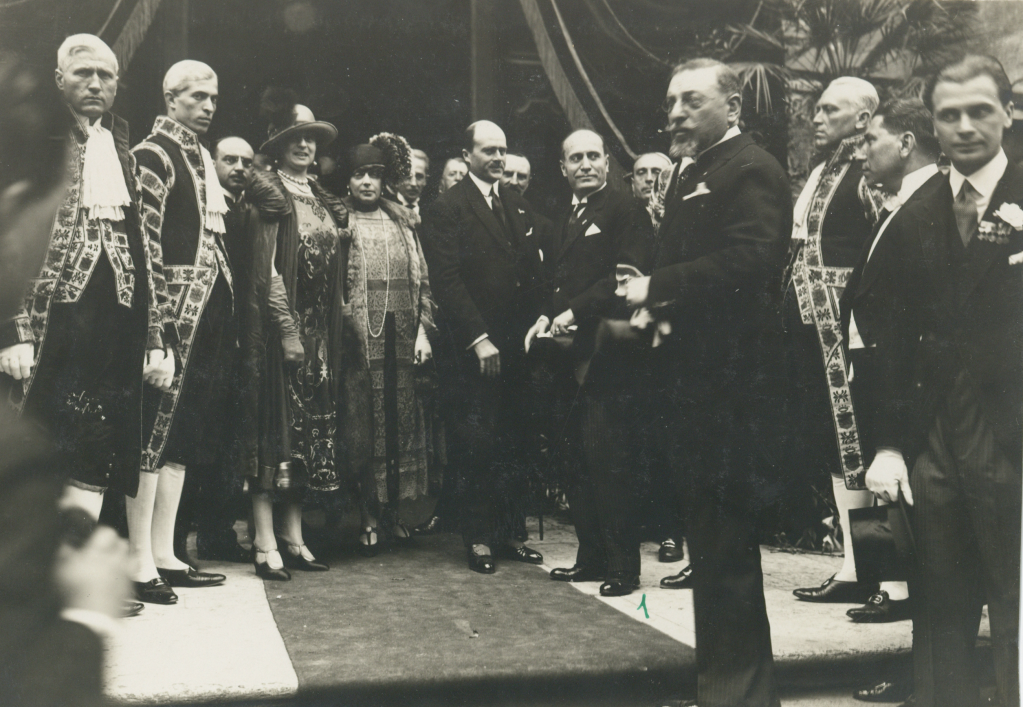
Post-wedding festivities at the Casino dell’Aurora, afternoon of 11 June 1925. Standing on carpet at center, from left: Nicoletta Prinetti Castelletti (bride’s mother), Gabriele Lucchesi-Palli (bride’s mother-in-law), Francesco Boncompagni Ludovisi (bride’s father), Benito Mussolini (witness). Collection of HSH Princess Rita Boncompagni Ludovisi, Rome
Alexis Latterman (Kutztown University ’25) is currently pursuing an undergraduate degree in Art History, in the hopes of pursuing a career as a museum curator. In the summer of 2023, she was a member of the internship program of the Archivio Digitale Boncompagni Ludovisi, assisting with the population of the PROVENANCE ARCHIVIO BONCOMPAGNI LUDOVISI ONLINE (PABLO) database, as well as simultaneously conducting extensive research into photographs of the Boncompagni Ludovisi family. She sends a huge thank you to both professor T. Corey Brennan and HSH Princess Rita Boncompagni Ludovisi for having provided her with such an incredible archive of photographs to be able to work with and study. She is truly honored for having been included in this amazing opportunity!

The newly wed Count Annibale Brandolini d’Adda and Princess Laura Boncompagni Ludovisi, 11 June 1925. Collection of HSH Princess Rita Boncompagni Ludovisi, Rome
 Archivio Digitale Boncompagni Ludovisi
Leave a comment