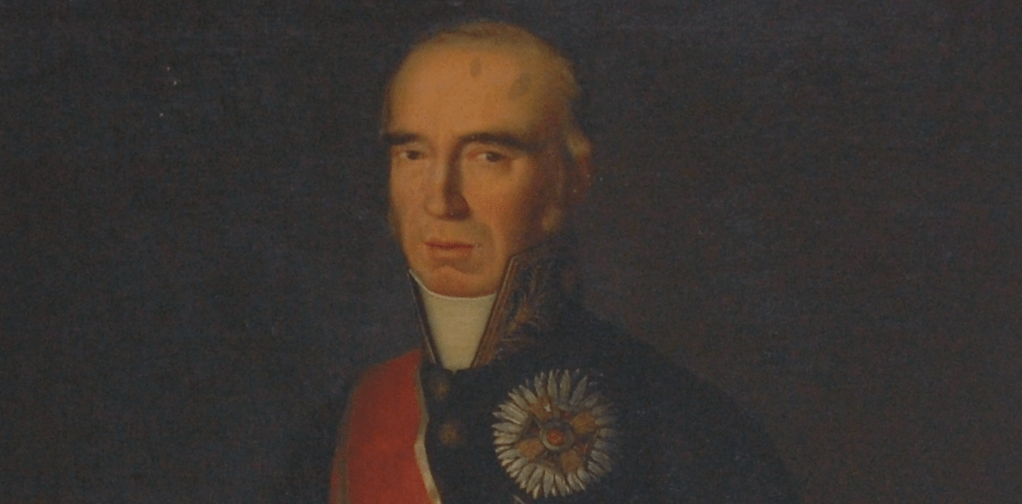
By Maxwell MacMillan (Kutztown University ’25)
How did the papal noble family of the Boncompagni Ludovisi fare during the very much anti-papal Napoleonic Kingdom of Italy (1805-1814)? Let’s start with the notice of a decree from Napoleon I himself—as opposed to one of his Italian subordinates. Dated 30 June 1811 and issued from his Tuileries Palace in Paris, it confirms Luigi Boncompagni Ludovisi (1767-1841, Prince of Piombino from 1805) as the Procurator (i.e., chief treasurer) of the Treasury of Rome.

Decree (30 June 1811) of Napoleon I from the Tuileries Palace in Paris appointing Luigi Boncompagni Ludovisi as paymaster of the Treasury of the (French) Crown in Rome. Luigi swore the oath of office in Paris (the Archive has the text) on 13 July 1811. [ABL prot. 590 no. 57.] Credit: HSH Princess Rita Boncompagni Ludovisi, Rome
What are the circumstances that brought Luigi Boncompagni Ludovisi to such a position? It is unexpected, given his descent from two Bolognese popes—as fifth great-grandson of Gregory XIII Boncompagni (1572-1585) and fourth great-grandnephew of Gregory XV Ludovisi (1621-1623). So how did that happen, in the midst of Napoleon’s aggressive campaign to conquer all of Europe despite, or perhaps in spite of, the losses he incurred?
Fortunately, the Archivio Boncompagni Ludovisi in Rome’s Casino dell’Aurora houses a large number of documents from Luigi’s time as Prince of Piombino (i.e., head of the family), as well as two detailed unpublished biographies of the man, written in the late 1940s by the noble family’s last archivist, Giuseppe Felici: Don Luigi I, Principe di Piombino (3 vols., Rome 1949) and I Boncompagni Ludovisi, Principi di Piombino, al Congresso di Vienna (1814-5) (8 vols., Rome 1949). Though these sources one gains deep insight into the character of Luigi and how it dictated his course to the point where we find him in this letter.
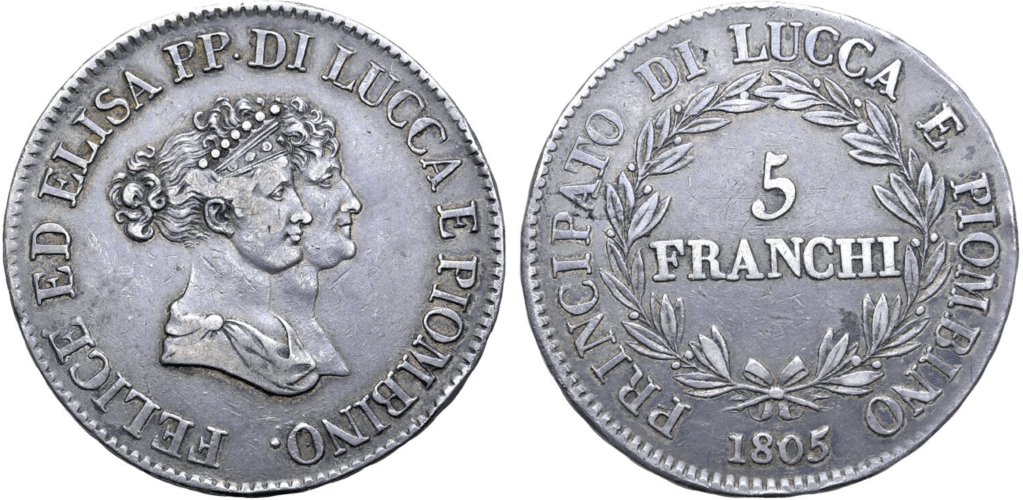
Lucca and Piombino (dated 1805), with jugate heads on obverse of Napoleon’s sister Elisa Bonaparte as the new Princess of Piombino, and her husband and co-ruler Felice Pasquale Baciocchi. Roma Numismatics Limited E-Sale 93 (1 June 2022) Lot 1625
Luigi was born on 27 April 1767 as the first son of Vittoria Sforza Cesarini and Antonio (II) Boncompagni Ludovisi, who in 1777 would succeed his father Gaetano as Prince of Piombino. The family lost their titular estates among other possessions during the War of the First Coalition in 1796 to Spain, a then-ally of the newly formed Republic of France. After Napoleon came to power in 1799, he assumed direct control of these territories by placing his sister Elisa Bonaparte in control of Tuscany as Grand Duchess, and Piombino as Princess of the territory. On 26 April 1805 Antonio II died and left Luigi the responsibility of recovering their lost territories.
Three years after Antonio’s death, Luigi made his first attempt at regaining the territories lost under his father. He appealed to Joseph Bonaparte, brother to Napoleon and then King of Naples and the Two Sicilies, who told Luigi his claim would be considered. Unfortuately, the letters we have documenting the event stop there (Felici, Don Luigi I, Principe di Piombino I 67).
However, only about a month after their meeting, on 10 January 1808, General Sextius Alexandre François de Miollis of the Imperial French Army marched on and occupied Rome taking residence in the Castel Sant’Angelo (on this, see Susan Vandiver Nicassio, Imperial City: Rome under Napoleon, Chicago 2009. 172). A little more than a year later, on 10 June 1809, the French, tired of trying to bend Pope Pius VII Chiaramonti to their will, declared Rome an official Imperial City of the French Empire. Napoleon saw to the exile of the Pope, first in Savona on the Italian Riviera, and—by year’s end—in France itself.

Decree (24 July 1809) of the “Extraordinary Consulta of the Roman States” appointing Luigi Boncompagni Ludovisi as President of the commission in charge of the embellishments to be made at the entrance of ‘Ponte Molle’ (= Milvian Bridge) and a new promenade to be created outside Porta del Popolo. [ABL prot. 590 no. 55.] Credit: HSH Princess Rita Boncompagni Ludovisi, Rome
It is under this shift in circumstances that we can see Luigi change tactics (Vandiver Nicassio, Imperial City 171). In a letter dated 24 July 1809 (reproduced above)—only about a month after the declaration of Rome as an Imperial City of France—Luigi was appointed to the commission in charge of embellishments to the Piazza del Popolo in Rome. This letter marks the beginning of a series of appointments that Luigi attains to higher and higher, yet continually nominal, positions in the administration of Rome under the executive French council, the Consulta.
It is interesting that here Luigi Boncompagni Ludovisi is still addressed as “Prince”; in later commissions—starting consistently in 1811, as seen in Napoleon’s decree with which we began our survey—Luigi is pointedly called “Duke of Sora” (and not “Prince of Piombino”).

Decree (8 August 1809) of the “Extraordinary Consulta of the Roman States” appointing Luigi Boncompagni Ludovisi as provisional president of the Roman Senate in case of the absence of Luigi Braschi Onesti (1745-1816), Duke of Nemi (and nephew of Pope Pius VI), who was then Mayor of Rome. [ABL prot. 590 no. 55C.] Credit: HSH Princess Rita Boncompagni Ludovisi, Rome
After the commission for embellishments to public spaces, we find Luigi on 9 August 1809 appointed as member of the Senate of the City of Rome as well as provisional Senate President in the case of the actual President’s absence.
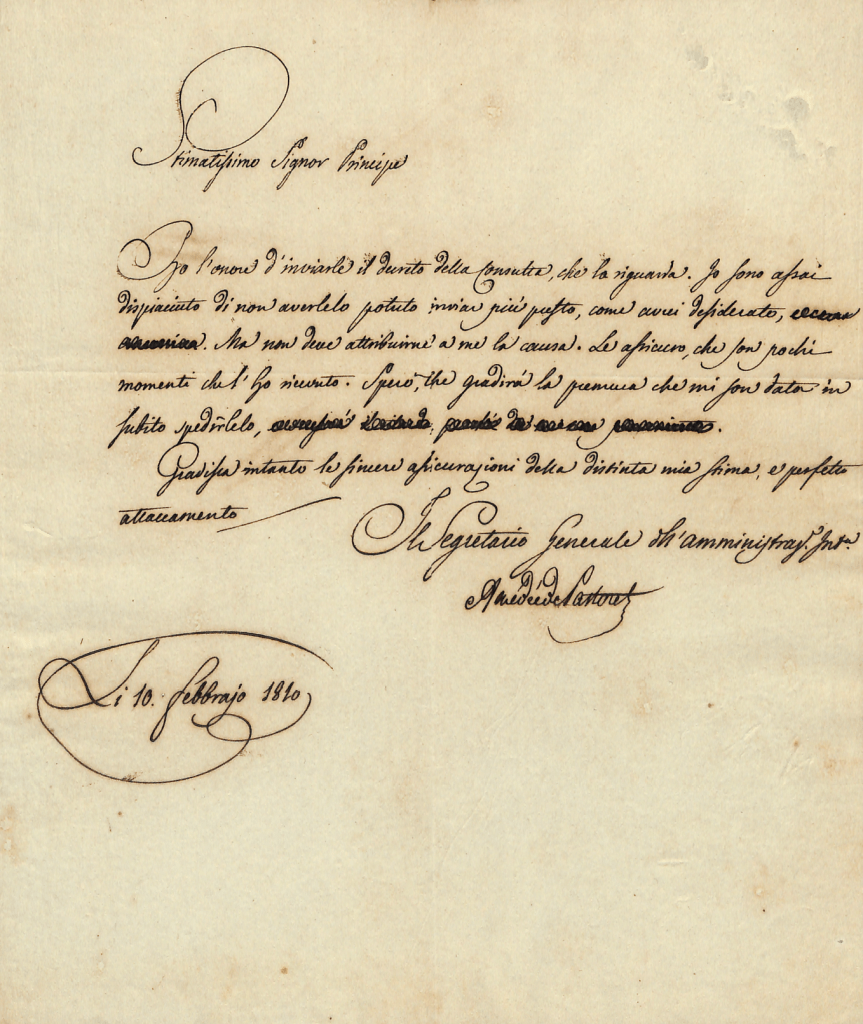
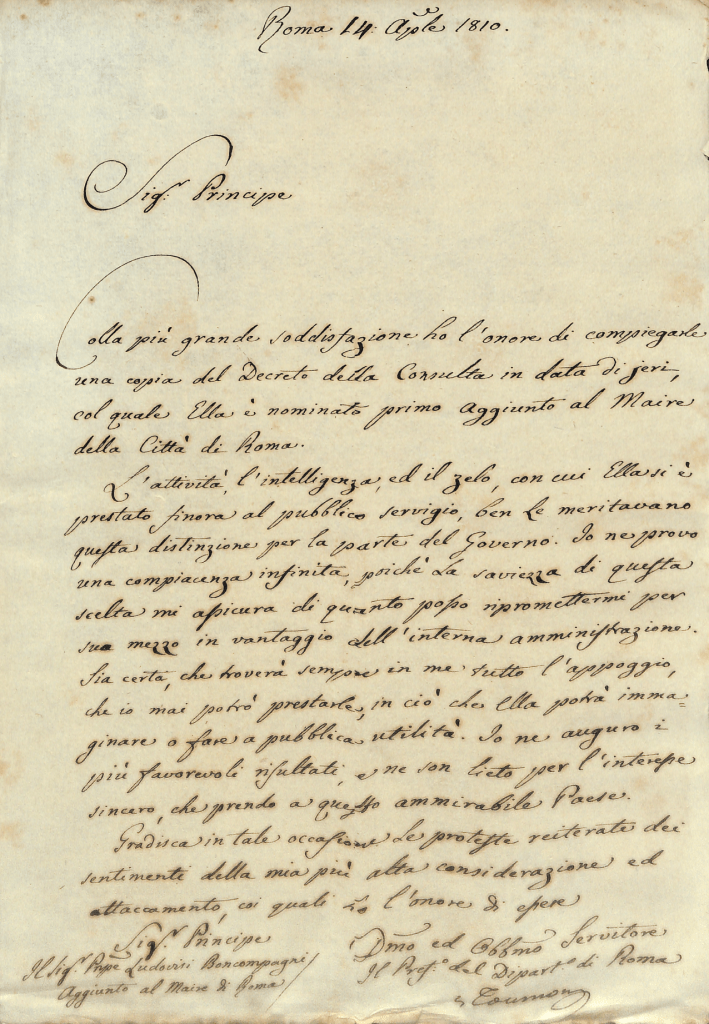
Decrees of the “Extraordinary Consulta of the Roman States” naming Luigi Boncompagni Ludovisi (above, 10 February 1810) as Vice-President of the Roman Senate, so that he can take part in the Administrative Commission of the City of Rome; and (below, 14 April 1810) as Adjutant to the Mayor of Rome. [ABL prot. 590 nos. 56 and 56A.] Credits: HSH Princess Rita Boncompagni Ludovisi, Rome
Further appointments follow: Vice-President of the Senate of Rome on 10 February of 1810; next, assistant to the Mayor of Rome on 14 April 1810 (each reproduced above). Eventually, on 15 March 1814, he would be named Mayor of Rome (see Timeline below).
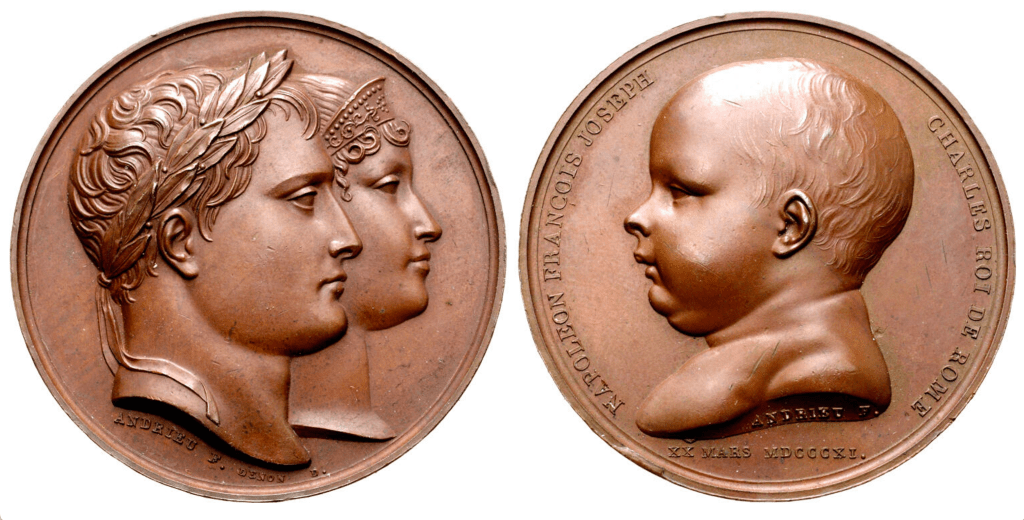
Medal (dated 20 March 1811) commemorating the birth of the King of Rome, Napoleon François Charles (= Napoleon II, 1811-1832). Napoleon I and (second wife) Marie Louise are pictured on obverse, and the infant Napoleon II on reverse. Roma Numismatics Limited E-Sale 85 (17 June 2021) Lot 1481.
Finally, a year later, we arrive at our initial letter of 30 June 1811, when Napoleon appoints Luigi as Procurator of the Treasury of Rome. This appointment comes directly from the Emperor, as opposed to all the previous appointments handled by the Consulta.
At this point Luigi was certainly starting to garner attention—not only from Napoleon himself, but surely from others in the city of Rome. In truth, by this point both the masses and the Pope (a virtual prisoner of Napoleon in France) rejected the occupying French government, and the nobility kept their fingers carefully in both the Napoleonic and Papal pies.
On 10 August 1810, “the Napoleonic government set up a commission to resolve the problem of reimbursing the holders of the enormous public debt” (Vandiver Nicassio, Imperial Rome 152). One part of their solution seems to have been an auction for holders of public debt of ecclesiastical properties. At these auctions, properties were exchanged for “certificates obtained in exchange for forced loans.” It so happens that Luigi and his father Antonio (II) had contributed—under coercion—a sizable amount in loans towards the revolution (Felici, Don Luigi I, Principe di Piombino 75).
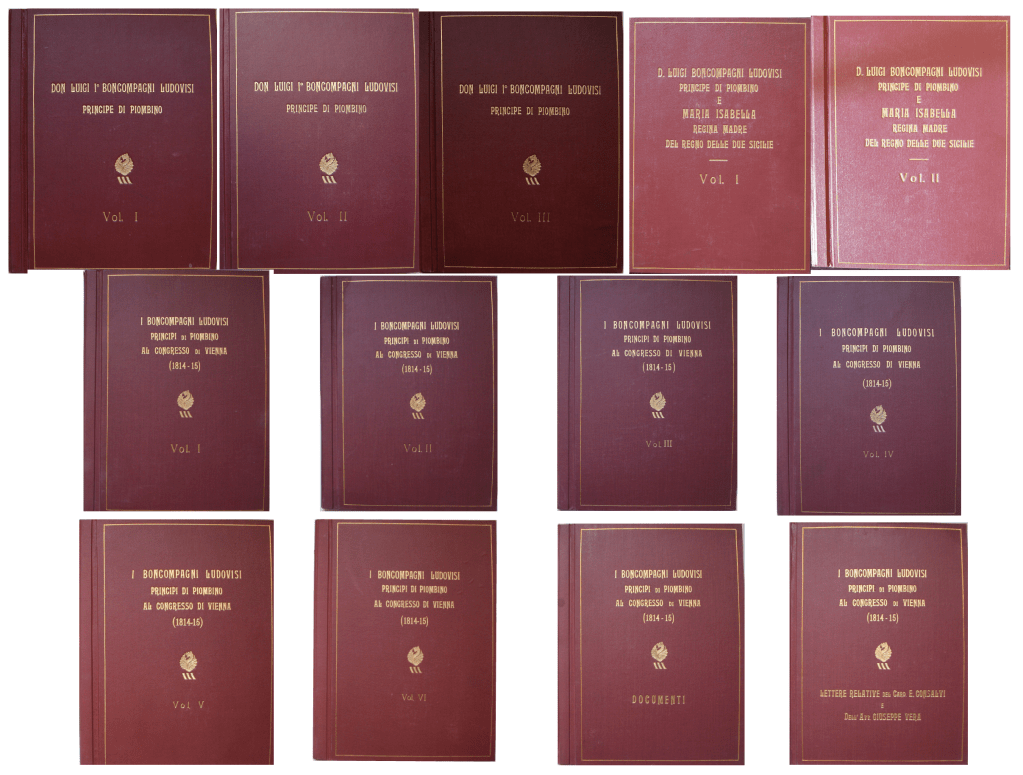
Unpublished works (in 13 volumes, all dated 1949) by Giuseppe Felici on the life and career of Luigi Boncompagni Ludovisi (1867-1841), prince of Piombino from 1805. Credit: HSH Princess Rita Boncompagni Ludovisi, Rome
At long last, Luigi sought recompensation for his lost properties by purchasing many new ones through these auctions. Based on these purchases and Luigi’s documented appeal to Joseph Bonaparte, Luigi seems to have considered the rebuilding and advancement of the Boncampagni Ludovisi family’s fiscal status more important than regaining their pride as feudal landowners. Considering the abolishment of the feudal state structure and the establishment of individual private ownership that occurred in France via the French Revolution, Luigi’s actions and ambitions can be thought of as looking towards an Italian future under Napoleon. However, this future would not come to be, and Luigi’s investment in its vision would come back to bite him in the end.
The years 1810 and 1811 can be considered the peak of Luigi’s efforts to build the Boncompagni Ludovisi family to an even greater status than they held before the loss of their titular lands to Napoleon. But for every mountain top there is a descent. Having fully invested his interests in the Napoleonic regime, it comes as no surprise that the years of 1814 and 1815 would see Luigi lose much of the progress he had made in restoring the fortunes of the Boncompagni Ludovisi family.
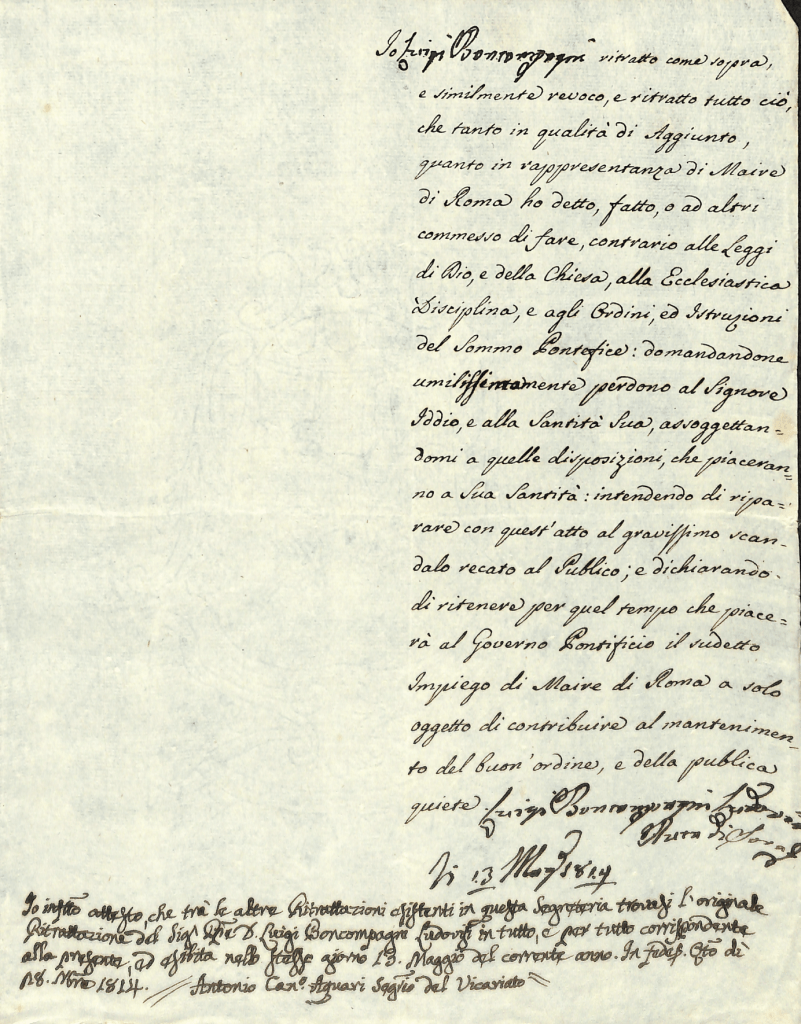
Letter (13 May 1814) from Luigi Boncompagni Ludovisi to Vatican Secretary of State Ercole Consalvi, formally revoking and retracting actions taken during Napoleonic rule in Rome. [ABL prot. 590 no. 60C]. Credit: HSH Princess Rita Boncompagni Ludovisi, Rome
A turning point comes in May of 1814. A month after Napoleon’s first exile, Luigi sent a letter revoking and retracting his actions under Napoleon’s regime. The letter of retraction was a light punishment considering how much Luigi had been benefiting under the French rulers.
However later in the year 1814, upon Pius VII’s return from exile to Rome, Luigi was pressured to cede a number of ecclesiastical properties he had bought from the French auctions for public debt holders (Felici, Don Luigi I, Principe di Piombino I 79). Surely, this had a more direct impact on Luigi than having to apologize and retract his actions under Napoleon. Luigi had insisted on keeping the land in spite of papal demands and in fact said in separate letters “do not fear the purple garb” and “my soul knows no fear.”
This surly attitude in communication with and about the church seems to indicate that the properties Luigi had gained held more value to him than the status he had gained under the French. Perhaps Luigi simply sought to preserve one set of victories among the many lost in the face of French defeat. In this endeavor he was somewhat successful, managing to keep a large number of the previously ecclesiastical properties and only having to cede a relative few.
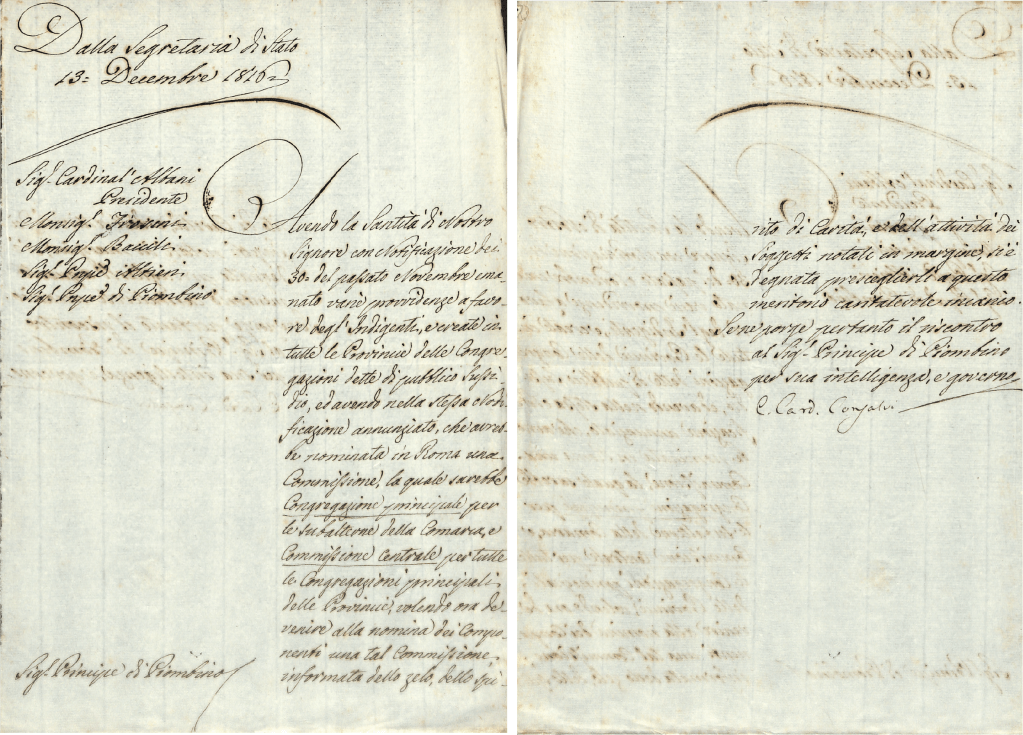
Letter (13 December 1816) of Cardinal Ercole Consalvi, Vatican Secretary of State, in which Luigi Boncompagni Ludovisi is appointed “one of the Members of the Principal Relief Commission for the Subalterns of the Comarca [i.e., territory of Rome], and of the Central Commission for all the principal Commissions of the Provinces of the Papal State” [ABL prot. 590 no. 62B.] Credit: HSH Princess Rita Boncompagni Ludovisi, Rome
Through his close connection with the affluent Vatican Secretary of State, Cardinal Ercole Consalvi, Luigi later (13 December 1816: see document above) secured a political position in the newly-reorganized Papal States, now restored to autonomy in a post-Napoleonic Europe.
That said, Luigi was never successful in regaining the territories Napoleon had taken from his father despite traveling to the Congress of Vienna personally to appeal for them. But that is another (and very complicated) story altogether.
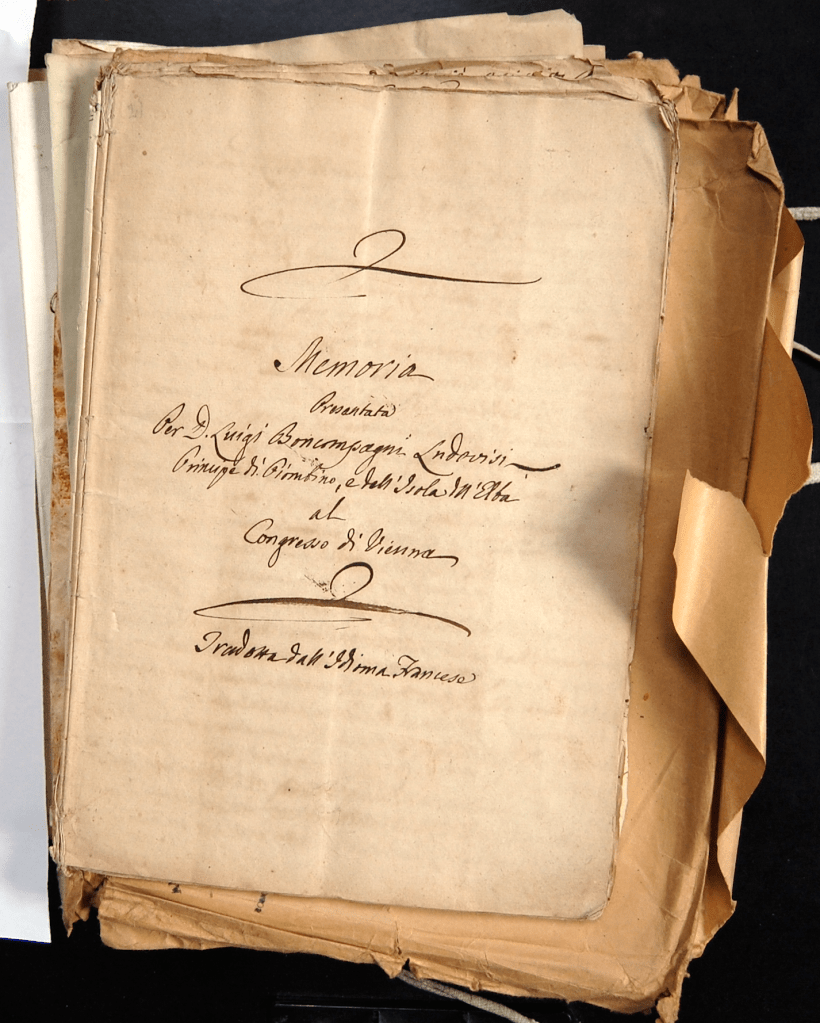
Manuscript in Archivio Boncompagni Ludovisi in Rome’s Casino dell’Aurora with Italian translation of Mémoire présenté par D. Louis Boncompagni – Ludovisi prince de Piombino et de l’Isle d’Elbe au Congrès de Vienne (published Paris 1814). Credit: HSH Princess Rita Boncompagni Ludovisi, Rome
TIMELINE
1767 (29 April) Luigi Boncompagni Ludovisi is born in Rome in the Palazzo Niccolini (now Ferrajoli) at Piazza Colonna to Antonio (II, 1735-1777) and Vittoria Sforza Cesarini (1743-1778), then Duke and Duchess of Sora
1796 (24 November) Luigi Boncompagni Ludovisi marries Maddalena Odescalchi (1782-1846)
1796 Antonio (II) Boncompagni Ludovisi loses the family states of Sora, Arpino, and Aquino to Ferdinand IV, King of Naples; he also loses the Marquisate of Vignola to the French; and Elba (part of the principality of Piombino) to the English
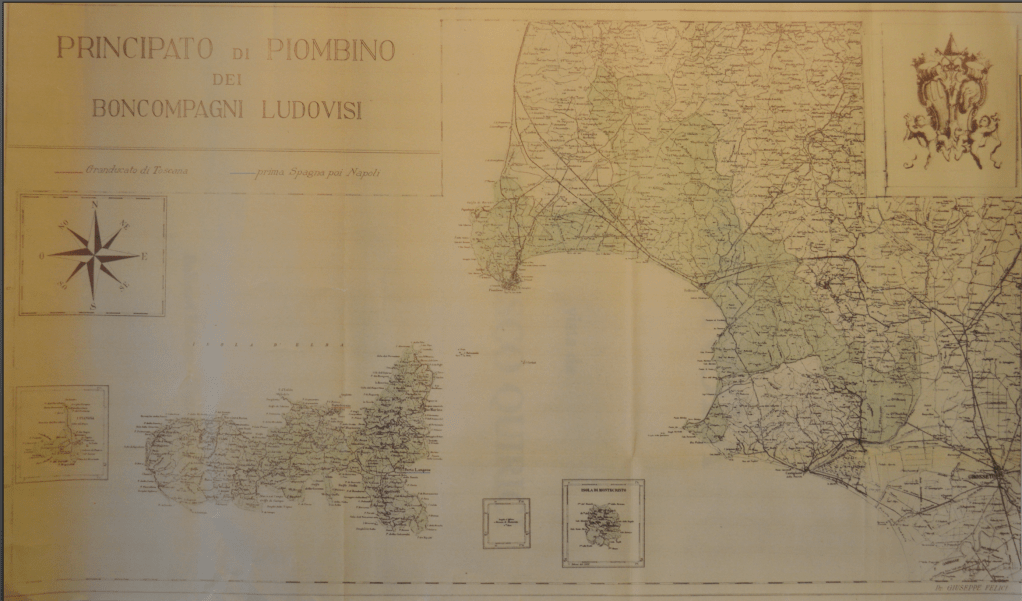
“The Principate of Piombino of the Boncompagni Ludovisi”. Map accompanying G. Felici, I Boncompagni Ludovisi, Principi di Piombino, al Congresso di Vienna (1814-5) vol. VI (1949). Credit: HSH Princess Rita Boncompagni Ludovisi, Rome
1801 Ferdinand IV himself is forced to submit to the peace conditions imposed by Bonaparte; among the various minor clauses was the cession to France of all rights to the investiture of the Principality of Piombino. Although the terms of the agreement did not formally compromise Boncompagni Ludovisi rights over that state, in reality, they allowed the Paris government to dispose of it freely—which it did without hesitation, expelling the family, which was stripped not only of its feudal rights but also of its allodial rights
1802 The island of Elba, a good portion which had ben historically attached to the Principality of Piombino, was annexed to France
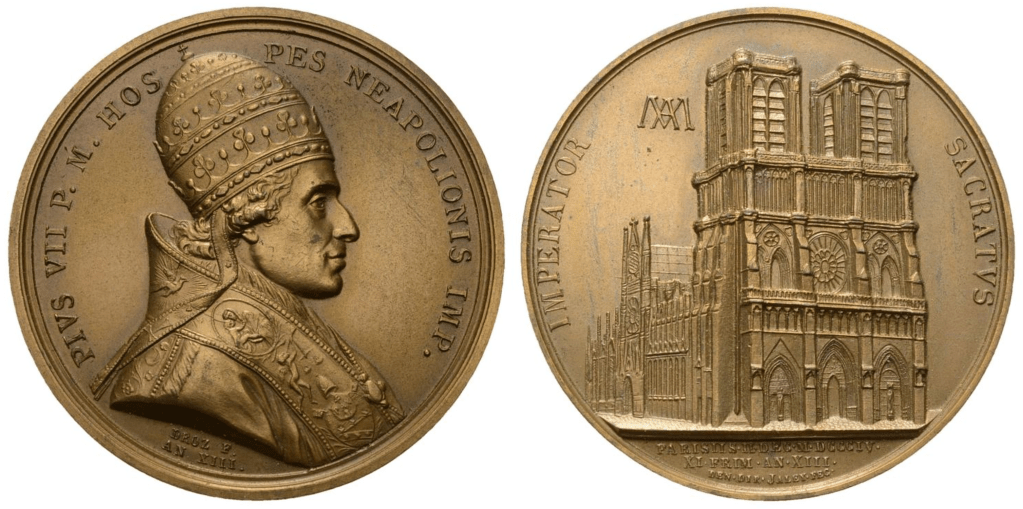
Paris: medal (dated 1804) commemorating, from the French perspective, the coronation of Napoleon I in Notre Dame by Pope Pius VII. Solidus Numismatik Auction 33 (15 September 2018) Lot 200
1804 (25 December) Napoleon I is crowned Emperor of France by the pope Pius VII
1805 (19 March) Napoleon grants the Principality of Piombino to his sister Elisa Bonaparte (1777-1820), with her husband Felice Pasquale Baciocchi (1762-1841) as co-ruler
1805 (26 April) Antonio II Boncompagni Ludovisi dies, and his son Luigi succeeds him as (now merely titular) Prince of Piombino, a position he would hold until 1841
1808 (January 10) Luigi appeals to Joseph Bonaparte, then King of Naples and Sicily under Napoleon, to regain properties lost under his predecessor Ferdinand IV that had been put up for public auction (Felici, Don Luigi I, Principe di Piombino I 67)
1808 (2 February) General Miollis under Napoleon occupies the Castel Sant’Angelo in Rome, beginning seven years of French occupation of the city
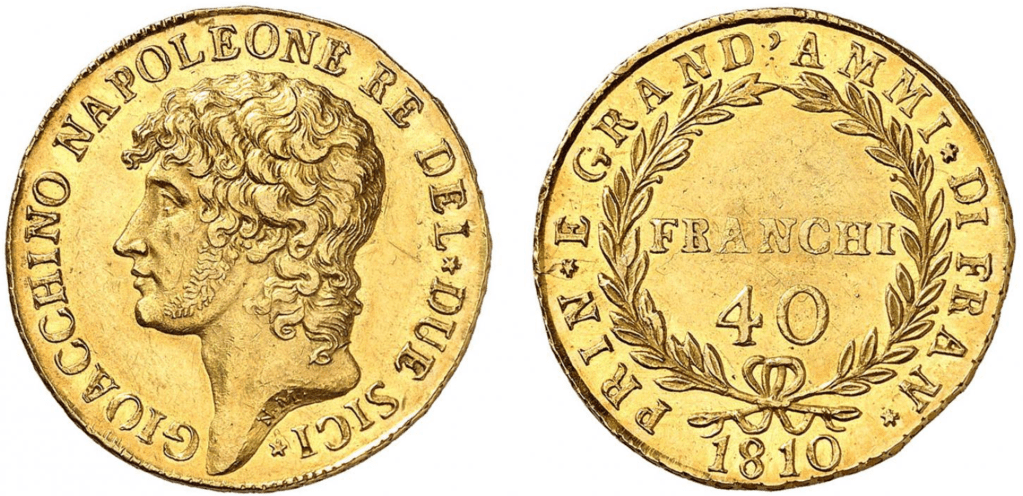
Naples (dated 1810): 40 francs coin (AV) of Joachim Murat, King of the Two Sicilies 1808-1815. Numismatica Genevensis Auction 10 (3 December 2018) Lot 431
1808 (September) Joseph Napoleon is transferred from Naples to reign in Spain and Joachim Murat, Napoleon’s brother in law, succeeds in his place
1809 (10 June) “The ancient city of Rome passed from independence as the seat of empire and the seat of the Church, to the ambiguous status of an imperial city, associated and then amalgamated with France. The best men that Napoleon had to offer came to restore the ancient city, to embellish the existing city and to create a modern one” (Vandiver Nicassio, Imperial City 171).
1809 (24 July) By decree of the Extraordinary Council (the Consulta), Luigi Boncompagni Ludovisi is appointed a member of the Commission in charge of the embellishments to be made to the “Ponte Molle Avenue” and the promenade to be formed outside the Porta del Popolo (letter reproduced above)
1809 (7 August) Appointment of Luigi Boncompagni Ludovisi as member of the Senate of the City of Rome (letter reproduced above)
1809 (12 August) Appointment of Luigi Boncompagni Ludovisi as Provisional President of the Senate of the City of Rome in absence of Duke Braschi (letter reproduced above)
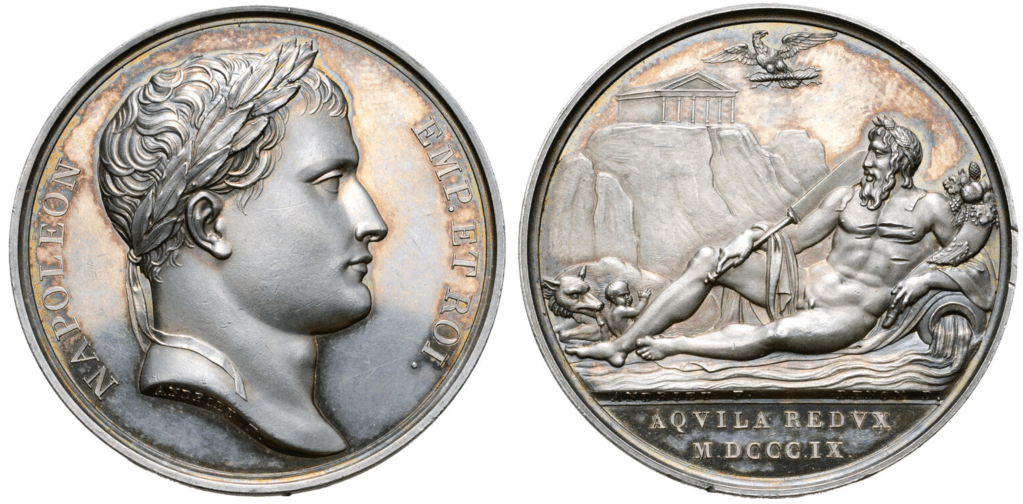
Napoleon I medal (AR) commemorating the annexation of Rome to France, dated 1809. The reverse shows a personification of the Tiber reclining (with rudder and cornucopia), with a she-wolf and infant to his left; in background, the temple of Jupiter Capitolinus, with an eagle carrying a thunderbolt. Roma Numismatics Limited Auction 24 (28 March 2022) Lot 1832
1810 (10 February) Appointment of Luigi Boncompagni Ludovisi as Vice-President of the Roman Senate to be part of the Administrative Commission of the City of Rome (letter reproduced above)
1810 (14 April) Luigi Boncompagni Ludovisi appointed as one of the assistants (adjunct) to the mayor of Rome (letter reproduced above)
1810 (10 August) The Napoleonic government in Rome sets set up a commission to resolve the problem of reimbursing the holders of the enormous public debt. Two years later, in a fiscal manoeuvre that even Camille de Tournon (Prefect of Rome, 1809-1814) admitted he did not understand, the debt was slashed even further, solving the problem on paper but devastating the investors who had held the promissory notes on the debt. (Vandiver Nicassio, Imperial City 152)
1811 (24 June) Luigi Boncompagni Ludovisi appointed as the King’s Procurator for “our” Municipality in Rome by Napoleon, Treasurer for the Crown in Rome (letter reproduced above)
1811 (24 June) Luigi buys a garden belonging to the convent of S. Nicola da Tolentino at Vicolo delle Palme from an auction organized by the French (Felici, Don Luigi I, Principe di Piombino I 75)
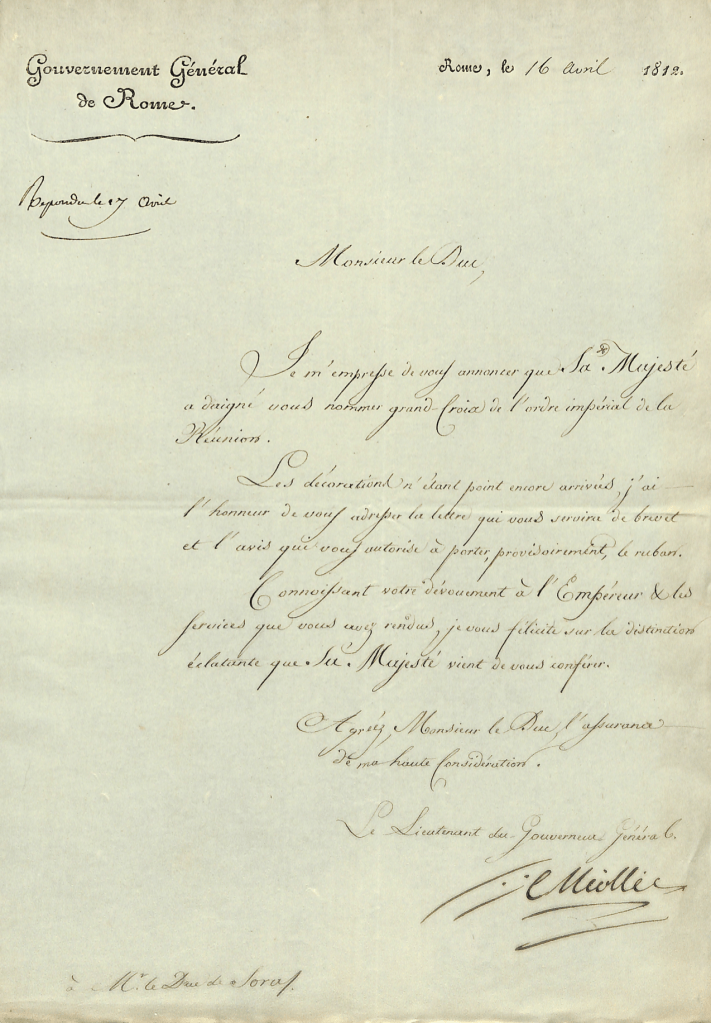
Letter (16 April 1812) from General Miollis, then governor of the former Papal States, to Luigi Boncompagni Ludovisi conveying Napoleon’s decision (22 February 1812) to grant him the Grand Cross of the Imperial Order of the Reunion. [ABL prot. 590 no. 58.] Credit: HSH Princess Rita Boncompagni Ludovisi, Rome
1812 Luigi Boncompagni Ludovisi buys up numerous properties in Rome and Frascati sold by the Consulta to ease public debt, including (3 November) for 19,000 francs at the southern border of his Villa Ludovisi “a small garden coming from the suppressed convent of S. Isidoro a Capo le Case ” as well as the convent house of the Irish missionary fathers (excluding the church)
1813 Luigi acquires the fiefdom of Monterotondo from Don Filippo Agapito (VI) Grillo (1770-1820), Duke of both Mondragone and Monterotondo (Don Luigi I, Principe di Piombino I 79). The title “Duke of Monterotondo” is henceforth hereditary in the Boncompagni Ludovisi family
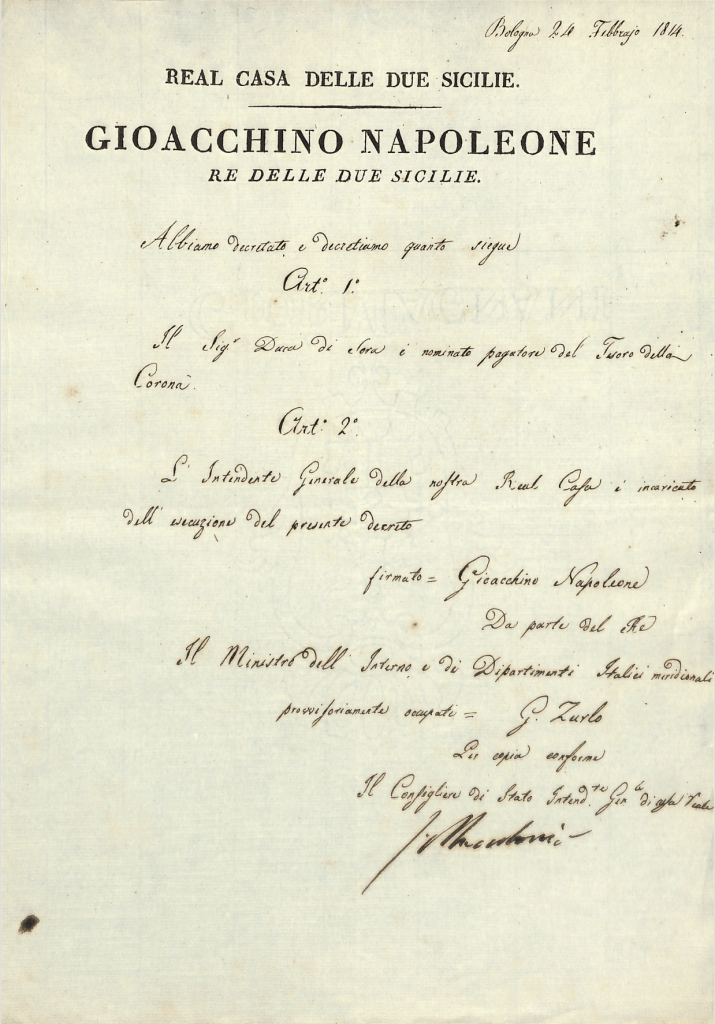
Decree (24 February 1814) by King of the Two Sicilies Gioacchino Napoleone (=Joachim Murat) in which he appoints Luigi Boncompagni Ludovisi Paymaster of the Crown Treasury in Rome. [ABL prot. 590 no. 60.] Credit: HSH Princess Rita Boncompagni Ludovisi, Rome
1814 (24 February) Appointment of Paymaster of the Crown Treasury in Rome conferred on Prince Luigi Boncompagni Ludovisi (document directly above)
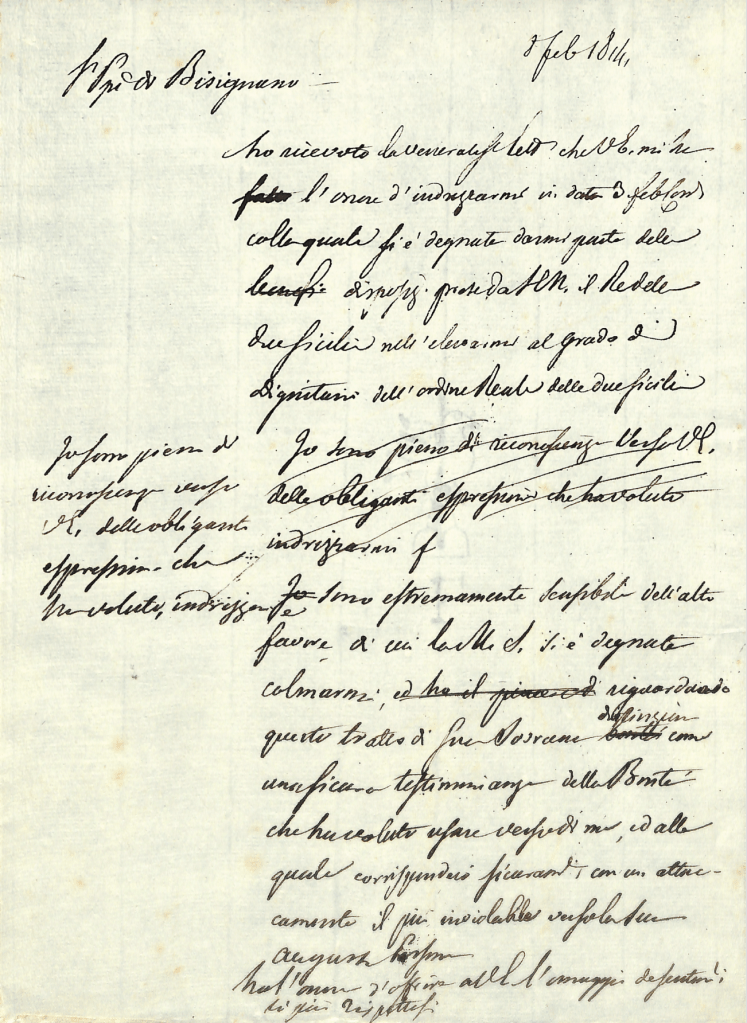
Draft of Luigi’s letter of acceptance (8 Feb. 1814) of Grand Dignitary of the Royal Order of the Two Sicilies, to be sent to Tommaso Sanseverino (1759-1814), 14th Prince of Bisignano, and then Minister of State in the Kingdom of Naples. [ABL prot. 590 no. 60A.] Credit: HSH Princess Rita Boncompagni Ludovisi, Rome
1814 (28 January) Appointment of Grand Dignitary of the Royal Order of the Two Sicilies conferred on Luigi Boncompagni Ludovisi (see directly above).
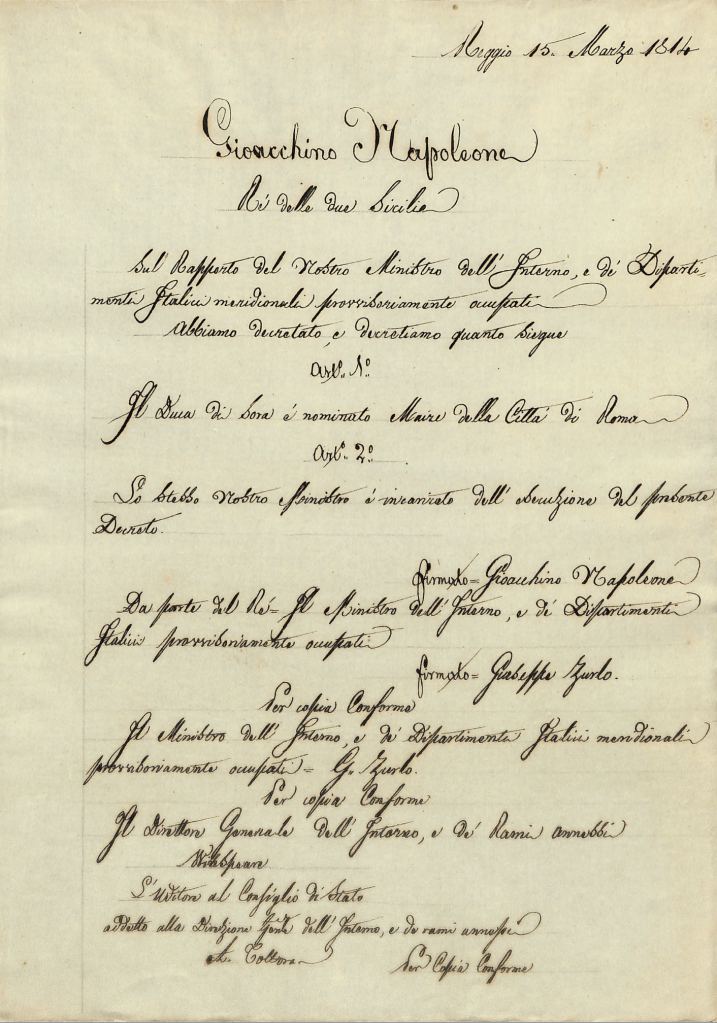
Decree (15 March 1814) by Gioacchino Napoleone (=Joachim Murat) in which he appoints Luigi Boncompagni Ludovisi Mayor of the City of Rome. [ABL prot. 590 no. 60B.] Credit: HSH Princess Rita Boncompagni Ludovisi, Rome
1814 (15 March) Appointment of office Mayor of the City of Rome conferred on Prince Luigi Boncompagni Ludovisi by King of the Two Sicilies Joachim Murat = Giocchino Napoleone (document directly above)
1814 (4 April) Napoleon, defeated in the field, abdicates and Louis XVIII was restored to the French throne; Napoleon is exiled to Elba
1814 (13 May) Luigi Boncompagni Ludovisi issues declaration of revocation and retraction of actions carried out during the era of the French Empire under the reign of His Majesty Napoleon I (document reproduced in text above)
1814 Upon Napoleon’s fall and Pius VII return to Rome, Luigi Boncompagni Ludovi is forced to cede a number of ecclesiastical properties he bought under the French Regime (Felici, Don Luigi I, Principe di Piombino I 79)
1814 (1 November) Congress of Vienna opens; publication (coinciding with it) of Mémoire présenté par D. Louis Boncompagni – Ludovisi prince de Piombino et de l’Isle d’Elbe au Congrès de Vienne (Paris: Strauss)
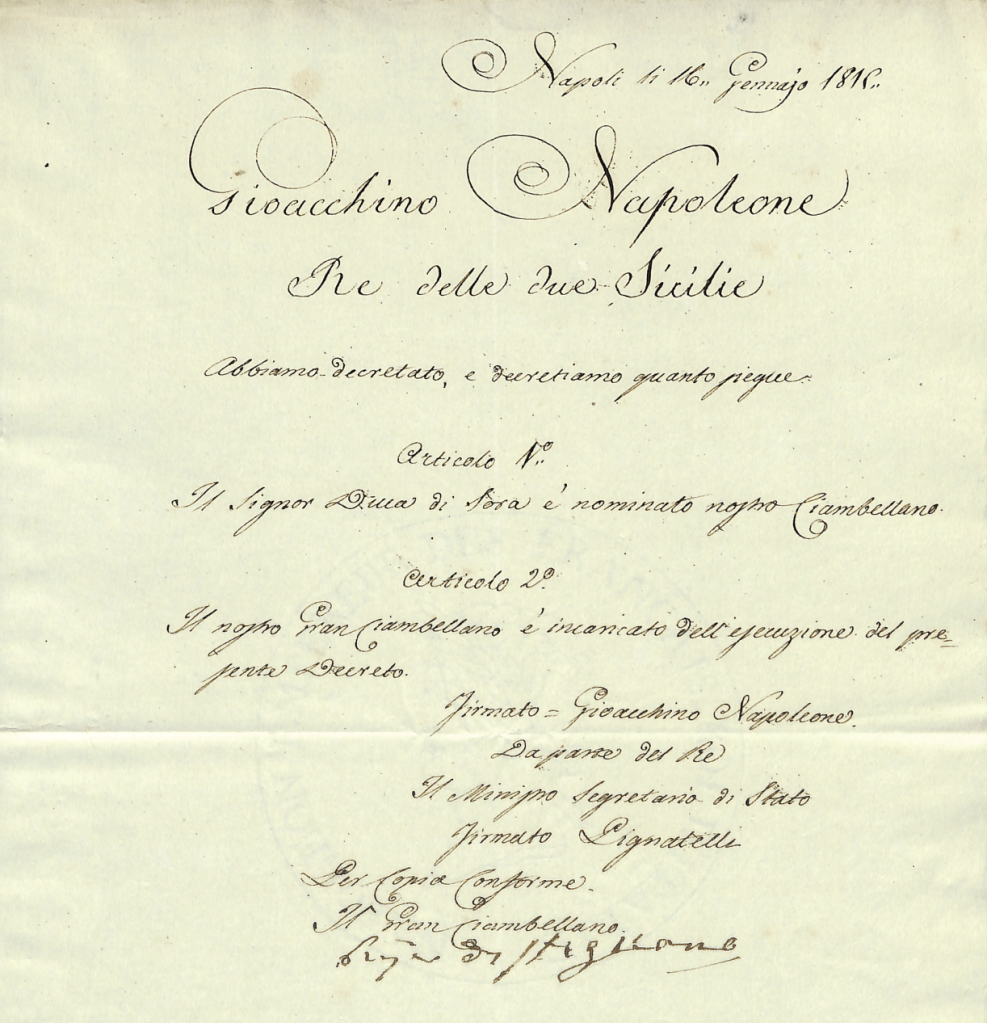
Decree (16 January 1815) issued from Naples by Gioacchino Napoleone (= Joachim Murat) in which he appoints Luigi Boncompagni Ludovisi his Champberlain. [ABL prot. 590 no. 61.] Credit: HSH Princess Rita Boncompagni Ludovisi, Rome
1815 (16 January) Luigi appointed as Chamberlain to Joachim Murat, then King of the Two Sicilies (document directly above)
1815 (9 June) Treaty of Vienna, Article 100: The Principality of Piombino is transferred to the Grand Duchy of Tuscany, under the control of Archduke Ferdinand of Austria; “Prince Ludovisi Buoncompagni shall retain, for himself and his legitimate successors, all the [private] property which his family possessed in the principality of Piombino, and in the island of Elba and its dependencies, previously to the occupation of those countries by the French troops in 1799, together with the mines, founderies, and salt mines. The Prince Ludovisi shall likewise preserve his right of fishery….”
1815 (18 June) defeat of Napoleon at Waterloo; Murat flees to Corsica, and is captured and killed in a disastrous raid of Calabria on 13 October.
1816 (28 August) Luigi Boncompagni Ludovisi begins to collect back payments for the liquidation of the Principality of Piombino under terms decided at the Congress of Vienna
1816 (December 13) Decree of Cardinal Ercole Consalvi, Vatican Secretary of State, appointing Luigi Boncompagni Ludovisi as one of the members of the Principal Commission of the Holy Office for the subordinate territories of the Comarca, and of the Pontifical Commission for all the principal Commissions of the Provinces of the Papal States (document reproduced in text above)
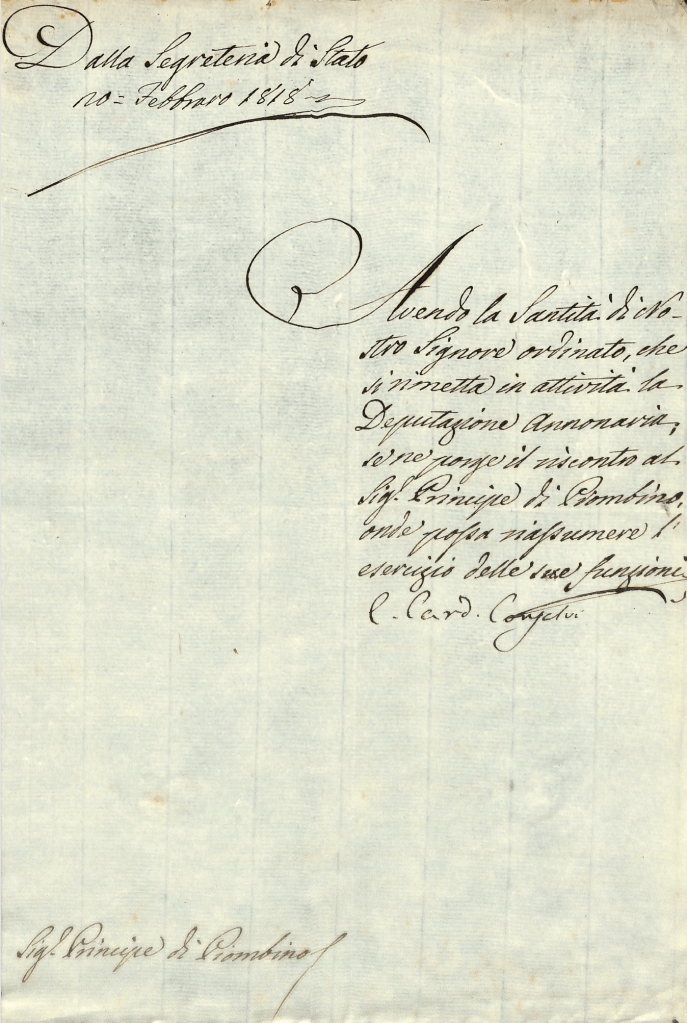
Dispatch (20 February 1818) of Cardinal Ercole Consalvi, Vatican Secretary of State, in which he appoints Luigi Boncompagni Ludovisi Deputy for Rome’s grain supply (annona). [ABL prot. 590 no. 63.] Credit: HSH Princess Rita Boncompagni Ludovisi, Rome
ABOUT THE AUTHOR: Maxwell MacMillan is an undergraduate student of Art History, minoring in Studio Art, at Kutztown University in Pennsylvania. He participated in the internship program at the Archivio Digitale Boncompagni Ludovisi during the Fall of 2024. Max writes “I’ve had an amazing time working with Dr. Brennan to piece together the life of Luigi under the Napoleonic regime. Dr. Brennan has been instrumental in helping me to translate letters and to place them into a developed historical context. To Dr. Brennan and HSH Princess Rita Boncompagni Ludovisi I am incredibly grateful to have been given the opportunity to work on a project with such rich historical depth and to experience the joys of working so closely with the primary documentation available through the archive.”
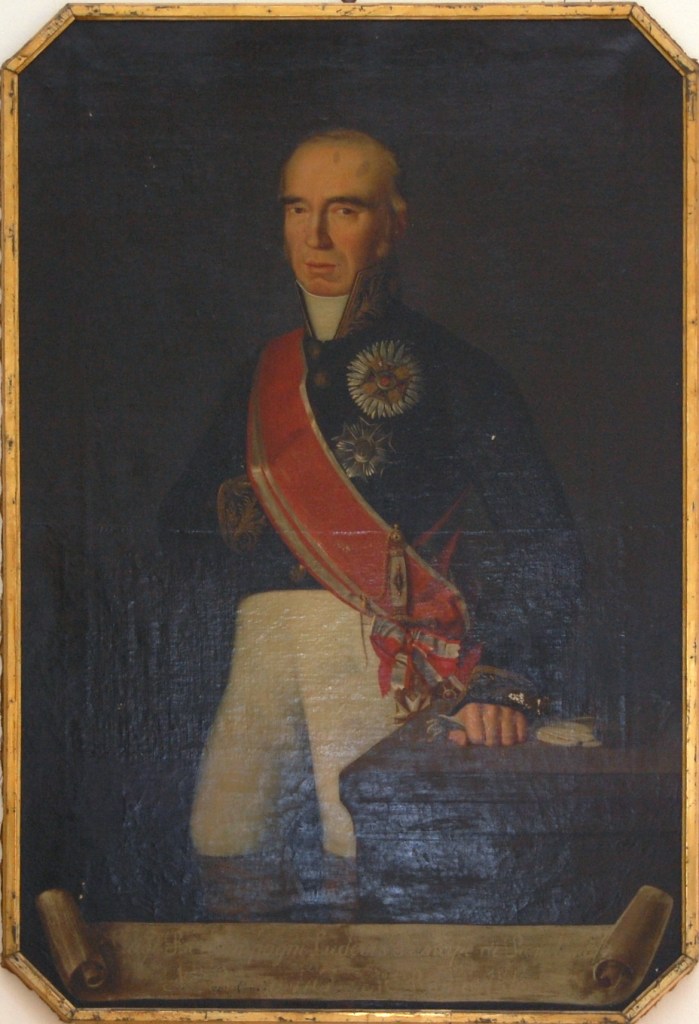
Portrait of Luigi Boncompagni Ludovisi (1767-1841, Prince of Piombino from 1805), apparently in the general era of the Congress of Vienna (1814-1815). Casino dell’Aurora, Rome
 Archivio Digitale Boncompagni Ludovisi
Leave a comment