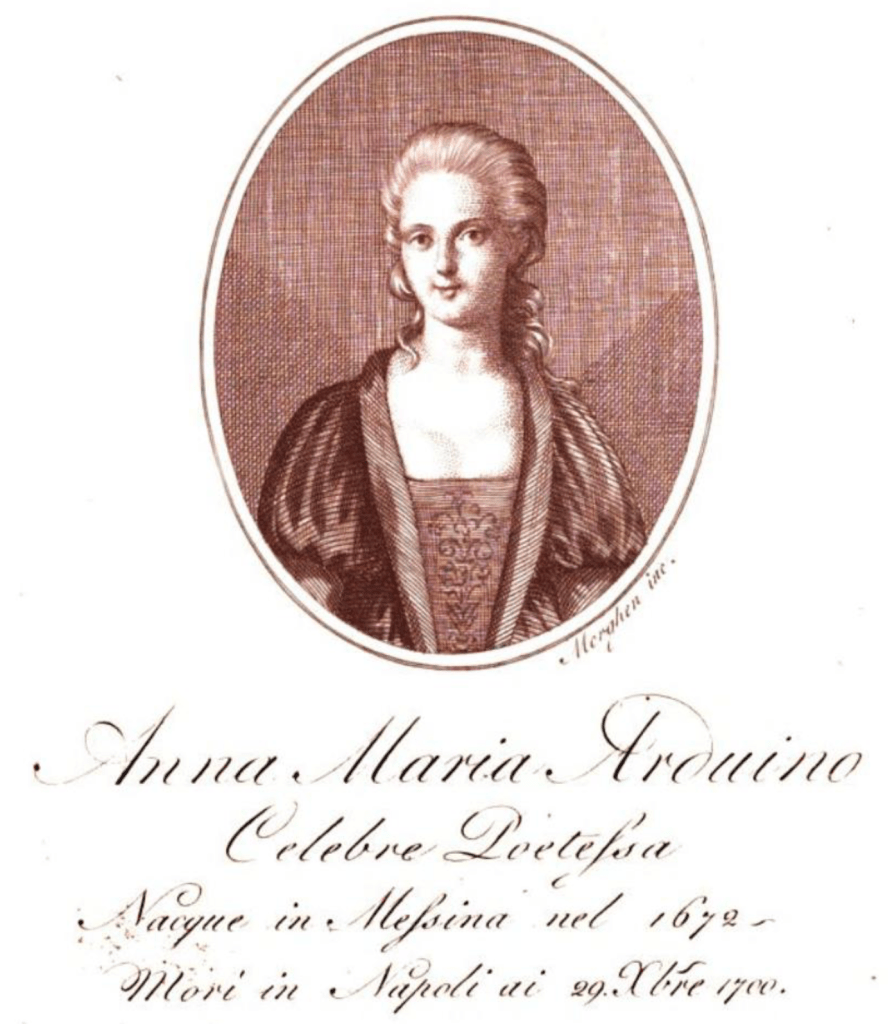
Portrait of Anna Maria Arduino (1672-1700), Princess of Piombino from late 1696. Source: G. E. Ortolani, Biografia degli uomini illustri della Sicilia IV (1821)
By Sarah Freeman (University of Pennsylvania ’29)
Just within the entrance of the church of San Diego all’Ospedaletto in Naples, a pair of marble monuments stand tall, enclosed in elaborate Baroque frames, flanking the central door. On the right hand side, from a medallion, a young noblewoman gazes out. She is presented in an idealized form, her drapery falling around her as one of her hands rests gently across her chest, while the other holds a small book. An intricately carved frame with a repeating pattern surrounds her portrait medallion. Beneath it sits a carved Latin inscription. Winged putti appear on either side, looking on mournfully, as a crown motif signifies the woman’s princely status.

Within the counter-facade of S Diego all’Ospedaletto, the paired tombs (1703-1704) of Niccolò Ludovisi (†1700) at left, and his mother Anna Maria Arduino Ludovisi (†1700) at right. Credit: Chiesa di S Diego all’Ospedaletto, Napoli
Anna Maria Arduino Ludovisi was buried here after her death on 29 December 1700 in a tomb paired with that of her young son, Niccolò (II) Ludovisi (†1700). This grand funerary monument commemorates them together. Niccolò was the last male Ludovisi heir, making his early death especially significant for the family. But who was Anna Maria? Why was her life preserved in marble?
Anna Maria Arduino was born in the major Sicilian port city of Messina to a highly aristocratic family in 1672. She was the daughter of Paolo Arduino e Patti, Prince of Polizzi and Marquis of Floresta, and Anna (sometimes found as Giovanna) Furnari, from a Messinese family of ducal rank. Messina had a privileged position within the Kingdom of Sicily, then ruled by Charles II of Spain. In 1674, Anna’s paternal uncle and maternal grandfather helped lead a revolt against royal interference in the city. A maternal uncle had fled to France even before the uprising. Anna Maria would have been six when the Spanish violently reimposed rule in Messina in 1678; though her father kept his position, the Furnari permanently lost their feudal properties.

Medal (1678, engraved by G. Hamerani) commemorating the end of the revolt of Messina. On obverse, Ludovico Portocarrero 1629-1729), Archbishop of Toledo and Captain General of Sicily 1677-1678. Credit: Aureo & Calicó Subasta 424 lot 176 (14 Dec 2023)
During her youth, Anna Maria was praised for her intelligence, beauty, and multitude of talents. Writing not long after Arduino’s death, Antonino Mongitore in his Bibliotheca sicula (1708) writes that “she was outstanding for her physical beauty. She was exceptionally skilled in music and painting, in embroidering cloth with the needle in the Phrygian [i.e., artistic] manner, and in leading dances. Endowed with marvelous gifts of intellect, she penetrated the mysteries of almost all the liberal arts and sciences. In particular she learned philosophy, rhetoric, poetry, and the more refined branches of literature beyond what was thought possible for her sex. On several occasions she defended philosophical theses with the greatest learning” (I p. 37).
An early 19th century biographer, Giuseppe Emanuele Ortolani, outlines Anna Maria Arduino’s early years. It was her father Prince Paolo, wanting to nurture her natural abilities, who ensured that she received this thorough education, including in both Italian and Latin literature. Anna Maria’s education reflected the literary world of Baroque Italy, where Classical authors remained important models for writers. She was especially drawn to Virgil, learning Latin so she could read the Aeneid in its original language. Virgil remained central to her Latin works, while Petrarch, an Italian scholar and one of the first Renaissance humanists, served as the model for her Italian poetry.
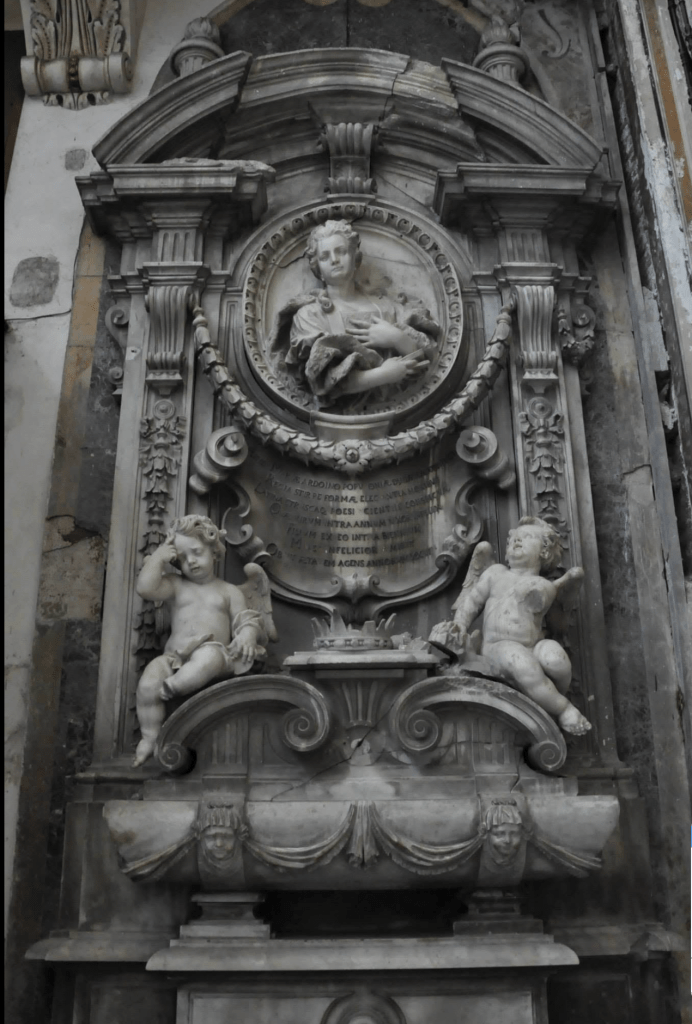
The funerary monument of Anna Maria Arduino Ludovisi (†1700). Credit: Chiesa di S Diego all’Ospedaletto, Napoli
Latin also allowed Anna Maria to access the elite literary circles of her time. After moving to Rome after marriage in 1697, she was admitted to the new Pontifical Academy of Arcadia, a prestigious literary society founded in 1690 to foster classical ideals. Like the other members of the Academy, she wrote under an Arcadian pseudonym: Getilde Faresia. She must have been a pioneering figure for other young noblewomen poets, such as Giacinta Orsini (1741-1759), who also was elected to the Academy of the Arcadians, before marrying into the Boncompagni Ludovisi family.
Anna Maria’s major Latin work was known as Rosa Parnassi plaudens triumpho imperiali, meaning “The Rose of Parnassus applauding the imperial triumph.” It was printed in Naples by Salvatore Castaldo in 1687. This poem was written in praise of Emperor Leopold I of Habsburg and his wife Eleonore Magdalene, Holy Roman Empress and Electress Palatine. The book, a quarto-sized volume in 52 pages, unfortunately is not digitized and can only be consulted at the Biblioteca Nazionale Vittorio Emanuele III in Naples.
What Anna Maria Arduino acheived here was rare. Erika Zimmerman Damer notes that only three women in early modern Italy are known to have written an entire volume of Latin poetry, and Anna Maria was one of them. (The other two are the Dominican nun Lorenza Strozzi [1515-1591] and Martha Marchina [1600-1646, published only posthumously].) This work also brought her directly into the political world, as she praised the Habsburg dynasty and participated in the public culture of imperial celebration.
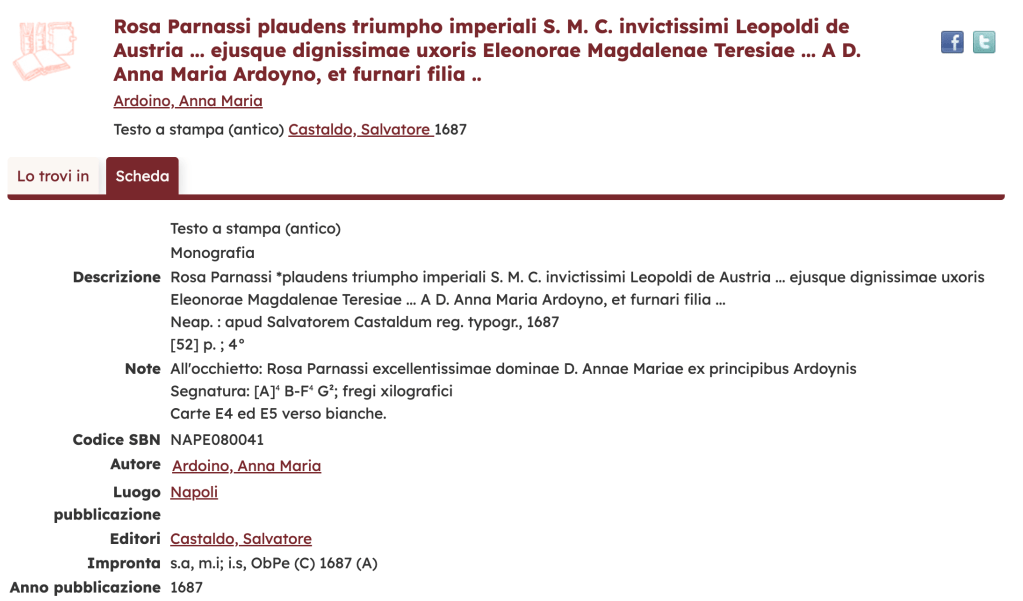
Catalogue entry for the sole known copy of Arduino’s Rosa Parnassi (1687) volume of poetry, in the collection of Bibliotheca Nazionale di Napoli
Anna Maria was only about fourteen or fifteen at the time of publishing Rosa Parnassi. Luisa Bergalli in her 1726 Componimenti poetici (II 288-289) reports that Anna Maria was already publishing Latin poetry “when she was a little more than ten years old”. While this claim may be embellished, or Bergalli is thinking of the Rosa Parnassi volume, it is clear that there was widespread knowledge of Anna Maria’s literary skill.
The work was notable enough to be recorded by Giovan Mario Crescimbeni (1663-1728), the influential historian and “custodian” (i.e., artistic director) of the Arcadian Academy, in his 1698 history of vernacular poetry, L’istoria della volgar poesia. He lists Anna Maria under “living poets” (pp. 169-170), with a short biographical notice: “Donna Anna Maria Ardoini Lodovisi of Messina, Princess of Piombino, known among the Arcadians as Getilde Faresia, a lady devoted to the most serious branches of learning. She has published a small volume of Latin poetry.”
Later in his work (p. 228), Crescimbeni prints two sonnets. One he wrote himself, in which he lavishly praises Anna Maria Arduino. He concludes that posterity does not need him to immortalize her as poet, because as a writer she can immortalize herself: ‘Da lei, ch’è sul di sè Musa, e soggetto. (“By her who, in regard to herself, is both Muse and subject.”) The other is a response by Anna Maria, who closely mirrors the wording and rhyme scheme of Crescimbeni’s sonnet but turns the compliments back at him.
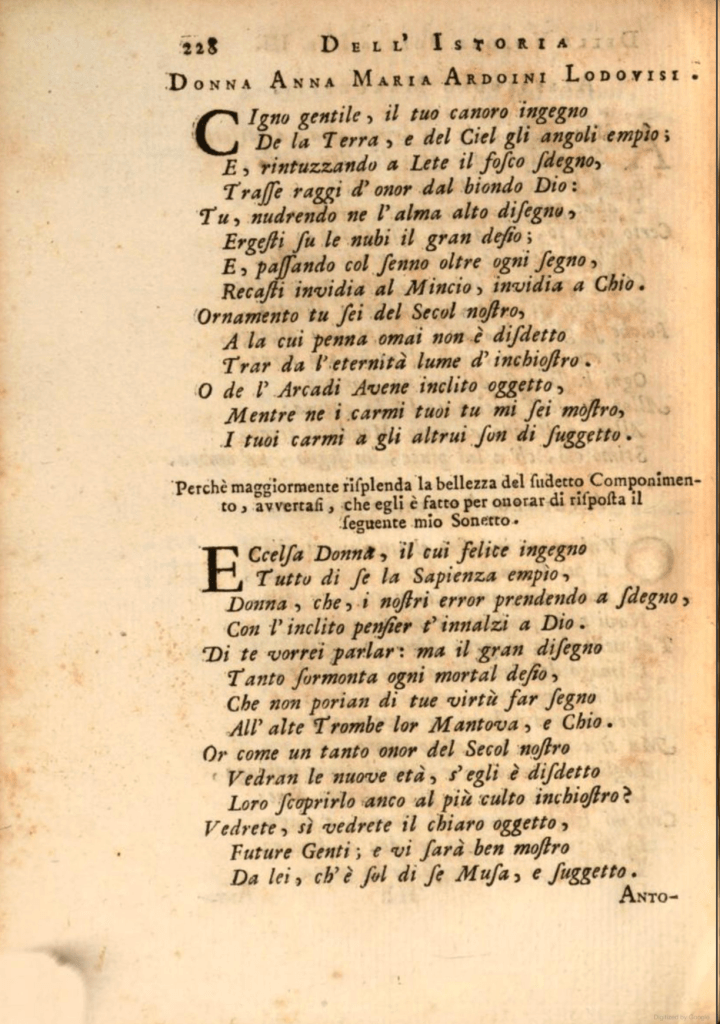
From G. M. Crescimbeni, L’istoria della volgar poesia (1698, p. 228), two poems delivered at the Academy of the Arcadians in 1697. The author’s poem praising Anna Maria Arduino, which initiated her response, is placed second; and the (improvised) response of Arduino is printed above it.
It so happens that we know precisely the circumstances of this responding pair of sonnets. They were delivered in 1697 at a gathering of the Arcadians. “Our most courteous Custodian Alfesibeo [Cario] [= Crescimbeni] recited a sonnet in praise of the most courteous and accomplished shepherdess Getilde Faresia [= Arduino], in which he stated that she ‘is of herself alone both Muse and subject.’ An extemporaneous composition for the same shepherdess.” So in other words Anna Maria composed this poem on the spot. The source for the exchange is a contemporary manuscript record in the Archivio dell’Arcadia, included by Marco Capriotti in his 2022 catalogue of Arcadian poetic improvisation [p. 359]. The archives of the Arcadians preserve reports of Anna Maria making other such “responses”—or in one case, declining a request of Crescimbeni, on the grounds that she was pregnant.
Other poems composed by Anna Maria Arduino were published only after her death, in an Arcadian compilation Rime degli Arcadi VI (1717). We find three in number. The first is her improvised response to Crescimbeni, that he had printed in 1698. The second must date precisely to 24 August 1700: Crescimbeni, we are told “had asked her for poetry to be recited at the ‘Ragunanza de’ forestieri’ [“Gathering of the Foreigners”], which that year fell on the anniversary of the death of her late husband, the Prince [i.e., Giambattista Ludovisi, d. 24 August 1699].” The occasion was a public Arcadian reading open to non-members of the Academy; Anna Maria offered a poem on how as a grieving widow she was unable to compose poetry. The third poem is a verse response to Cardinal Pietro Ottoboni (1667-1740), created a cardinal in 1689, an Arcadian who was one of the foremost patrons of music in her age.
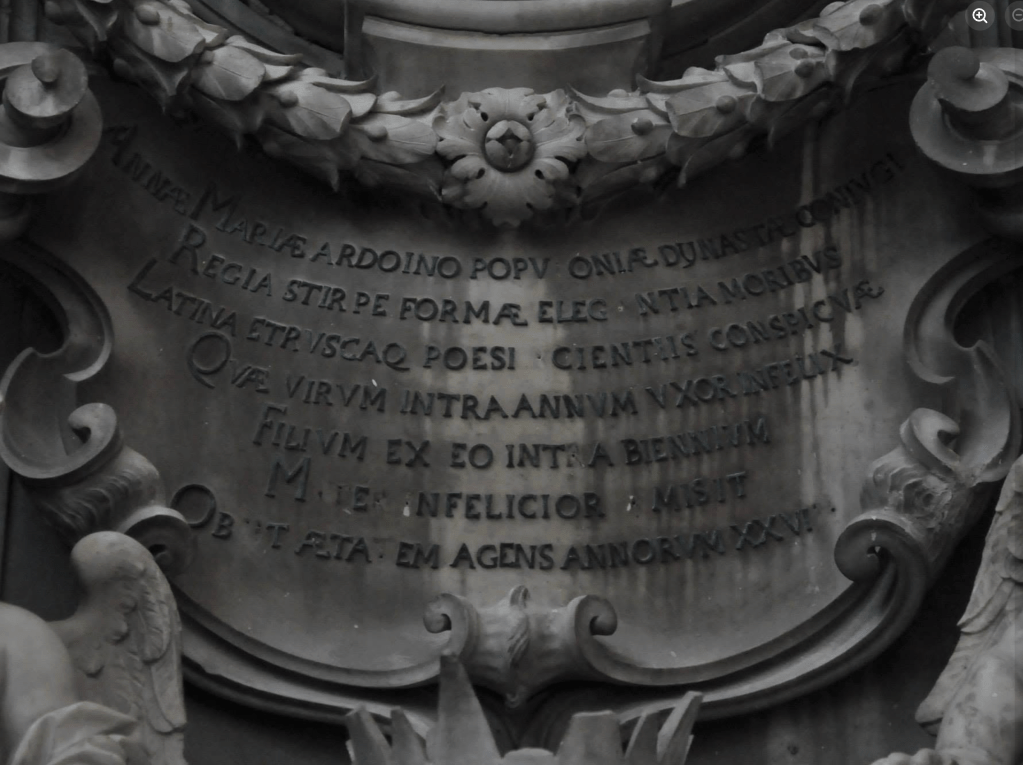
Latin inscription on the funerary monument of Anna Maria Arduino Ludovisi (†1700). Credit: Chiesa di S Diego all’Ospedaletto, Napoli
Amazingly, Anna Maria was also known for her work in the visual arts. We have seen that Antonino Mongitore in 1708 praised Anna Maria’s skill in painting. In his Memorie de’ pittori messinesi (1821), Giuseppe Grosso Cacopardo remembered her as an artist who painted “masterfully.” He seems personally to have seen many of her compositions. “It is true that she practiced the art of painting with her hand and her intellect not in order to earn her livelihood”, wrote Grosso Cacopardo, “but solely for her own pleasure; yet it is equally true that she knew how to handle the brush like a master, with liveliness and confidence…Recognizing the keenness of his daughter’s talent, [her father Prince Paolo] had her educated in Italian and Latin literature, as well as in the liberal arts, and especially in painting, as was then the universal custom [i.e., for elites] in Messina…Her family preserved a considerable number of paintings by her, which demonstrated the very great skill she possessed in that art.”
Anna Maria married Giovanni Battista Ludovisi, Prince of Piombino (born 1647) apparently in December 1696. We unfortunately do not have a precise date, though the coinage of Piombino (see image below) confirms the year. Giambattista was one of the greatest spendthrifts of the seventeenth century, and his reckless behavior put the remaining members of the Ludovisi family (he had two living sisters) under financial pressure, especially Ippolita, who married Giacomo (II) Boncompagni in 1681.
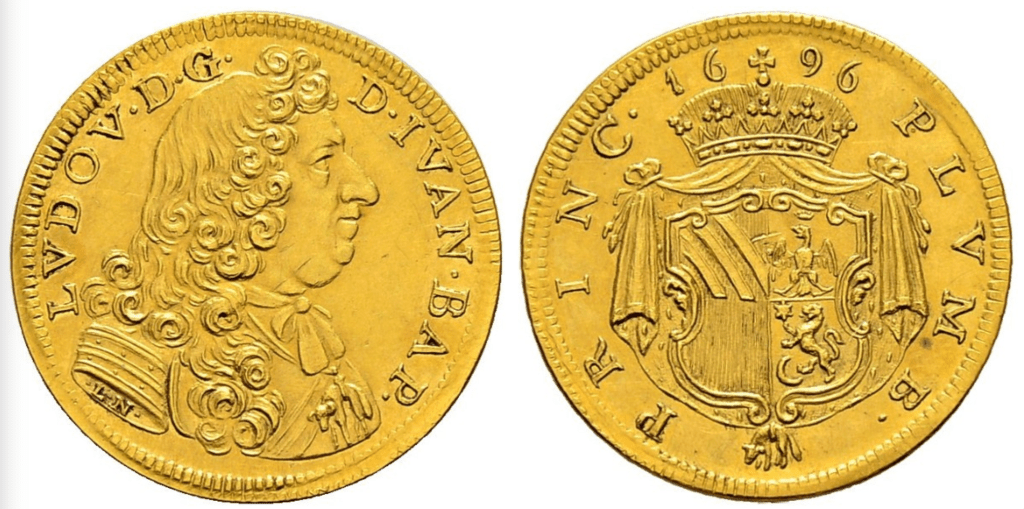
Giovanni Battista Ludovisi as Prince of Piombino, presentation zecchino dated 1696. The reverse shows the combined arms of the Ludovisi and Arduino families, and shows that the marriage took place in that year. Credit: Sincona Auction 29 Lot 1713 (18 May 2016).
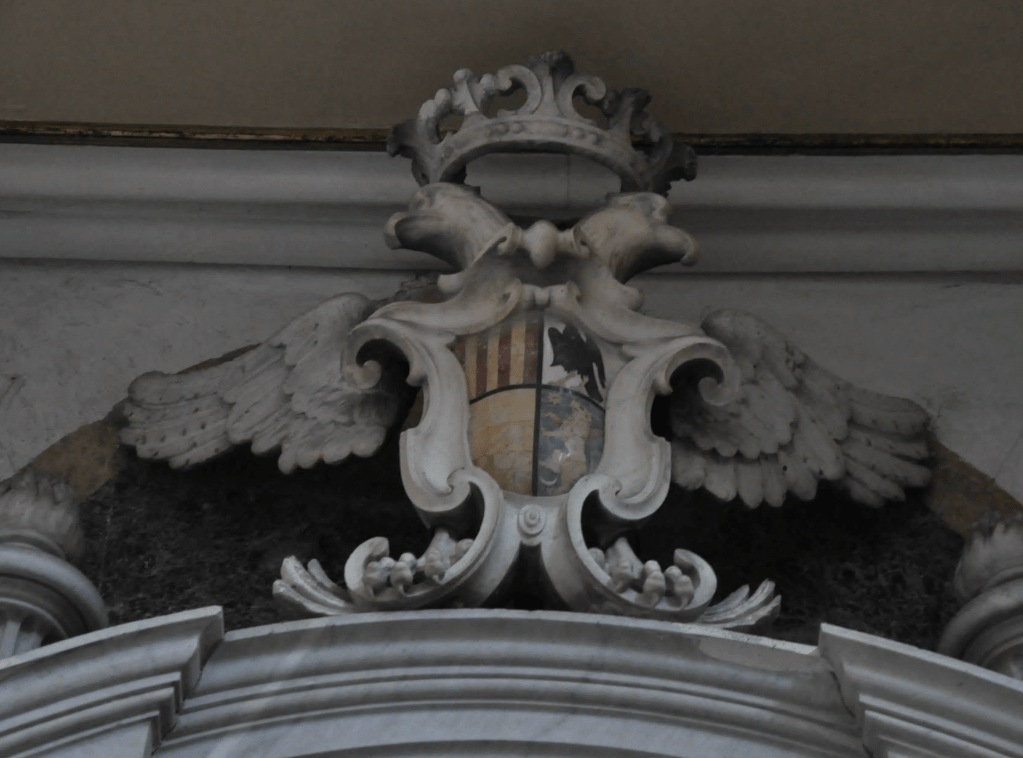
From the funerary monument of Niccolò (II) Ludovisi (†1700), a crowned double eagle displays the combined arms of the Ludovisi and Arduino families. Credit: Chiesa di S Diego all’Ospedaletto, Napoli
Giambattista had been married once before, to María de Moncada, daughter of a major Catalan noble, the Marquis of Aitona. The date of their wedding was 11 January 1669. In 1675 Giambattista returned from Spain with Moncada to live in Naples. By early 1683 the couple was clearly broke, because we find Moncada writing to the Queen of Spain, Marie Louise d’Orléans (1662–1689), complaining of their miserable condition and begging that King Charles II provide her husband with a royal post. In September 1683 Moncada raised the alarm that her husband had departed for the court of Flanders to fight as a common mercenary. Ludovisi was still in Brussels four years later, where he had accumulated so many debts that he feared imprisonment (Archivio Boncompagni Ludovisi prot. 331 nos. 51, 54, 56). Matters further spiraled downward, and Moncada died in February 1694. She and her husband had no children.
A 12 October 1695 document in the Casino dell’Aurora (Archivio Boncompagni Ludovisi prot. 605 no. 28) concerning the revenues of Piombino shows the difficult circumstances Prince Giambattista faced before the wealthy Anna Maria Arduino entered the family. The document sets out the income of the Ludovisi family from their principality of Piombino and suggests that Giambattista was in such a difficult position that he rented out the income of his principality to his sister. What makes this arrangement even more striking is that some years previous he had already in 1676 rented out his principality to a non-relative, which caused a financial mess resolved only in the mid-nineteenth century, after over 150 years of litigation.
Through this marriage, Anna Maria still became Princess of the sovereign principality of Piombino, joining Roman aristocratic society as a member of the Papal family of the Ludovisi. Her nineteenth century biographer G. E. Ortolani says on her departure to marry in Rome, “the poets of Messina wished her in verse a happy journey and a fortunate stay in the capital of the ancient world, filled with monuments of interest to those who cultivate literature.”
To celebrate her own wedding, Anna Maria composed a prologue in Italian for Apostolo Zeno’s musical drama I rivali generosi, or The Noble Rivals. Zeno was recognized as a pioneering figure in the reform of Italian opera, favoring historical drama and morality over comedic subplots. The work had premiered in Venice on 21 January 1697.
His drama, set in the Byzantine era, was staged by Anna Maria’s husband Giambattista in the gardens of his Villa Ludovisi. Giovanni Mario Crescimbeni, who was almost certainly present, praises the magnificence of the Prince’s production. It soon was published. though Anna Maria’s contribution is not credited, as Crescimbeni remarks in his obituary of the young woman. This performance falls within the tradition of vibrant aristocratic patronage that characterized seventeenth-century Rome. The event was also particularly striking, as it was the last performance of its kind ever held at the Villa Ludovisi up through its demolition in 1885.

Copy dated 18 July 1828 of the August 1699 birth certificate of Niccolò (II) Ludovisi. Courtesy of HSH Princess Rita Boncompagni Ludovisi, Rome.
The Archivio Boncompagni Ludovisi at Casino dell’Aurora preserves an 1828 copy of the baptism certificate of the son of Giambattista and Anna Maria Ludovisi. It reveals that he was born in the Tuscan hilltop town of Massa Marittima on 4 August 1699, and baptized six days later. The document (Archivio Boncompagni Ludovisi prot. 592 no. 46A) reflects on the fact that her husband had hit rock bottom, since he had to ask members of the lowest social order to serve as godparents. Niccolò’s birth certificate gives us one of the few official records of his short life. It also contradicts the funerary inscriptions, and also all biographies, that he was the posthumous son of Giambattista. I quote it in full:
“In the Holy Name of God, so be it. Certification by me, the undersigned Chancellor-Archivist of the Episcopal Curia of Massa Marittima in Tuscany, that in the Register of Baptisms of the Archpriestly Church of Saint Antimo Martyr in the city of Piombino in this Diocese, preserved in this public archive, there is found the following birth entry: On 10 August 1699 The Most Excellent Lord Don Niccolò Maria Domenico Placido, firstborn son of the Most Excellent Lord Prince Don Giovanni Battista Ludovisi, our Lord, and of the Most Excellent Lady Donna Anna Maria Arduino, Princess of Piombino, his lawful consort, was born on 4 August of the said year at one-thirty in the night (i.e. 1:30 a.m.), and was solemnly baptized by me, Archpriest Barsacchi, according to the rites of Holy Mother Church. His godfather was Maestro Antonio Mariani Ciabattino, known by the nickname ‘Imperatore delle Spiantiti’ [“Emperor of the Penniless”], and his godmother was Signora Tommasa Maria Parelli, midwife of Livorno. Extracted and collated with the original, to which it conforms. Given at Massa Marittima from the Episcopal Curia on 18 July 1828. Canon Luigi Bonsi (?), Episcopal Chancellor.”
Then, in rapid succession, the losses came. Two weeks after the baptism, on 24 August 1699, Giambattista died. Crescimbeni, following what he found stated on the funerary monuments, says that the couple had not yet been married a year, perhaps a mistake for “two years”, since Anna Maria certainly was in Rome in 1697. Giambattista’s death created a situation in which his three week old son became Prince of Piombino, and Anna Maria effectively his regent. It appears that the widow left Tuscany and headed to Naples with her infant son. The evidence for this is a series of legal actions that Giambattista’s sister Ippolita took between between 1702 and 1703 against Prince Paolo Arduino, alleging that his daughter on her departure removed not only her dowry goods but also a substantial amount of additional property that legally belonged to the Ludovisi household (see especially Archivio Boncompagni Ludovisi prot. 339 part III nos. 12-34).
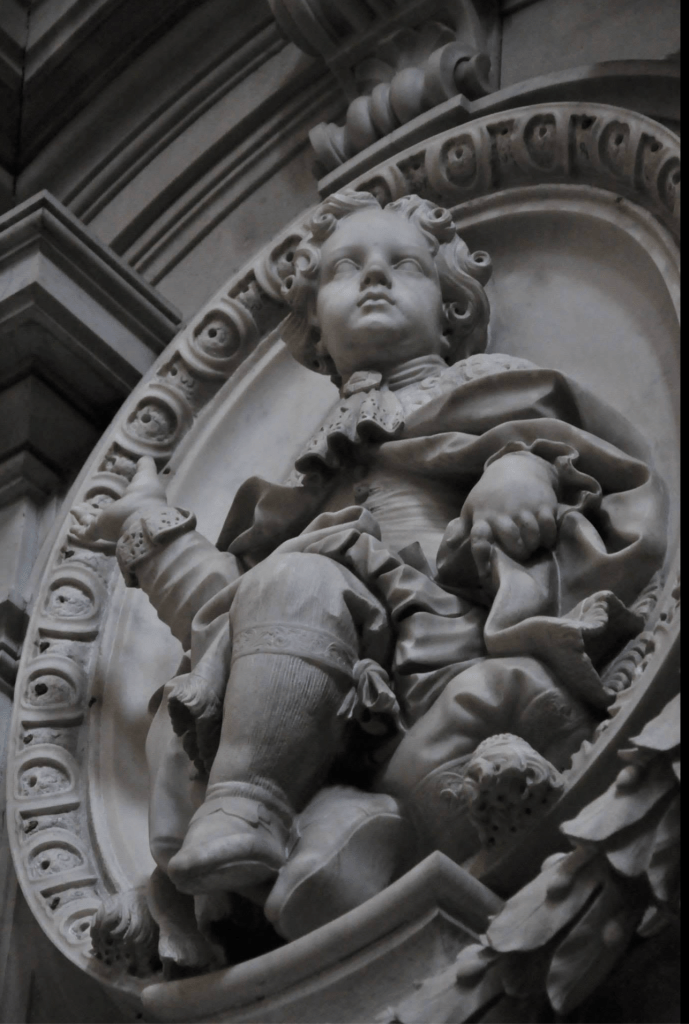
Full length high relief portrait of Niccolò (II) Ludovisi (†1700), from his funerary monument. Credit: Chiesa di S Diego all’Ospedaletto, Napoli
Amid this extreme tragedy, Anna Maria was praised for her piety and Christian resignation. As we have seen, in August 1700 she reluctantly performed her poetry at one of the major events of the Arcadians’ calendar on the first anniversary of her husband’s death. But then three of the last four Ludovisi died in rapid succession On 27 November 1700, Giambattista’s sister Olimpia, a nun (born 1656), passed away. In Naples, young Niccolò also died around this time, sometime in autumn or early winter 1700. Finally Anna Maria herself died in Naples on 29 December 1700, aged just 28.
The succession then moved to Giambattista’s youngest and sole surviving sister, Ippolita Ludovisi, and her husband Gregorio (II) Boncompagni, which brought the Ludovisi inheritance into the Boncompagni line. The two families formally merged to form the Boncompagni Ludovisi in March 1702.
Anna Maria Arduino became a subject for poets, who wrote not only about her departure from Messina and her wedding, but also mourned her death. Her Sicilian biographer Giuseppe Emanuele Ortolani (1758-1828) in his Biografia degli uomini illustri della Sicilia IV (1821, which aimed to offer biographies of the greatest Sicilians since antiquity) describes how he found a contemporary sonnet dedicated to her among the manuscripts of the Accademia della Fucina in Messina. An ancestor of Ortolani himself composed another poem mourning “the celebrated Maria Anna Arduino, Princess of Piombino.”
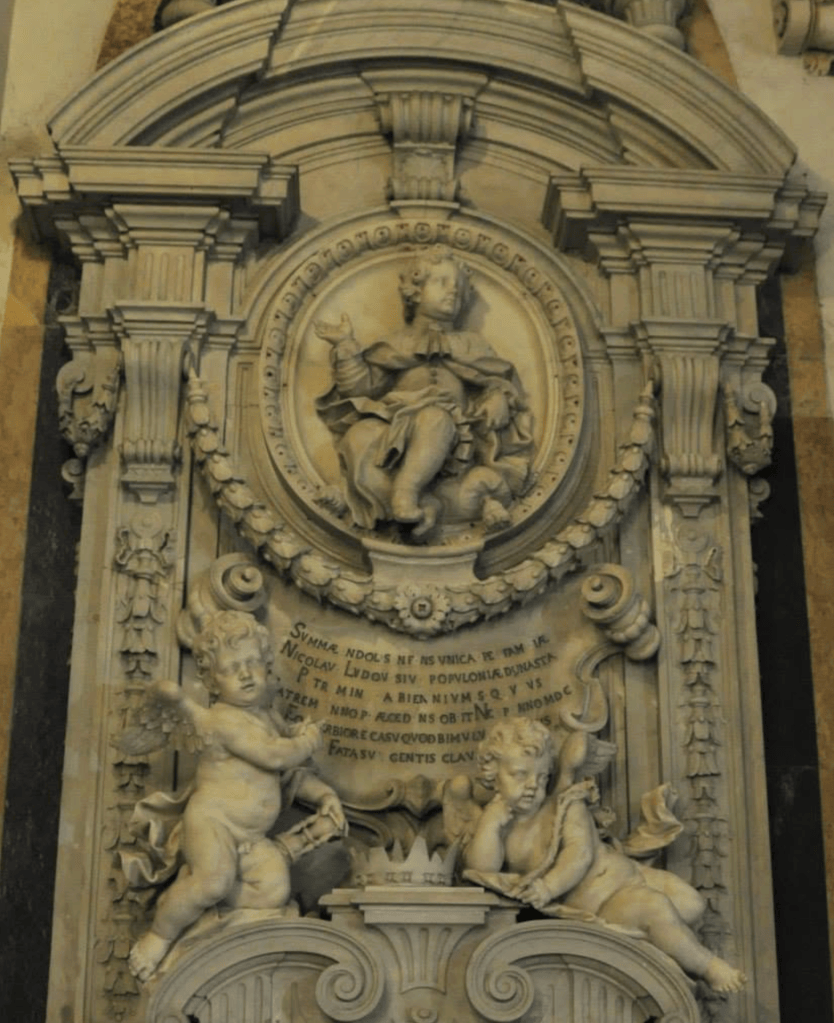
Funerary monument of Niccolò (II) Ludovisi (†1700). Credit: Chiesa di S Diego all’Ospedaletto, Napoli
Giuseppe Ortolani also describes the joint tomb of Anna Maria Arduino and her son Niccolò Ludovisi, identifying the sculptors: “on the inner façade of the church of San Diego in Naples (commonly called lo Spedaletto) there exists a noble marble monument to this distinguished poetess, designed by the celebrated [painter, architect and designer Francesco] Solimena [1657-1747] and executed by the accomplished sculptor Giacomo Colombo [1663-1741], with a half-length relief portrait of her. To the right of it may be seen the marble monument of her deceased son. Both of these celebrated tombs, with their respective figures and the heraldic arms of the illustrious house, display on their fronts their respective Latin inscriptions. From these we learn that her son, called Niccolò Lodovisio, died two years before his father [sic] and only one before his mother; and that she herself, rich in accomplishments and renowned for her study of Latin and Tuscan poetry, died in the twenty-eighth year of her age. In the inscription she is described as “Regia stirpe” [of royal lineage].
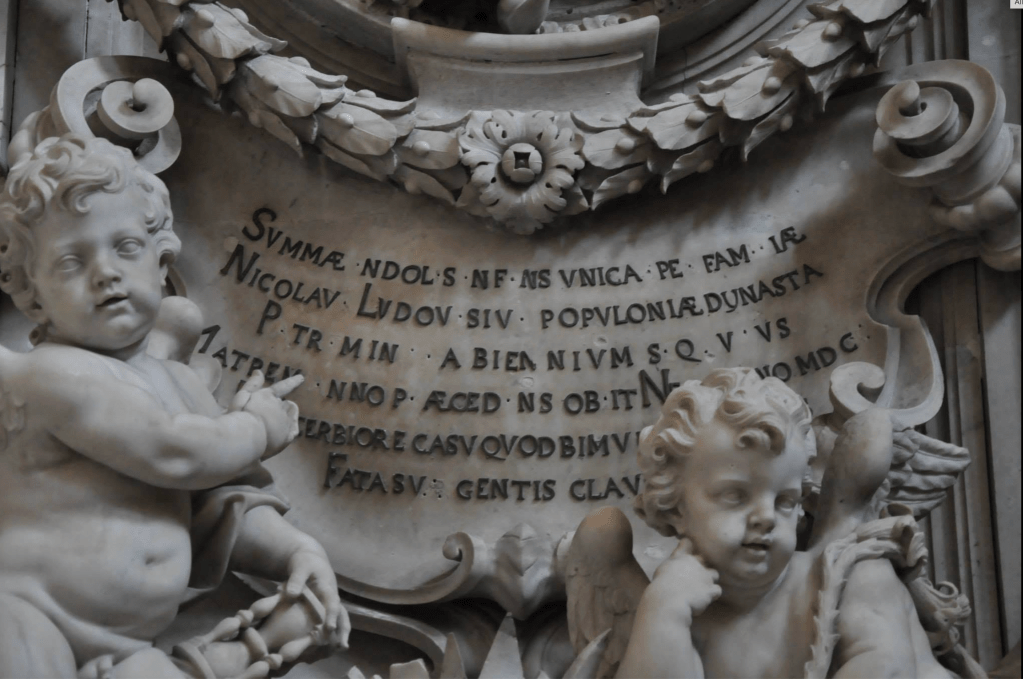
Latin inscription (with missing metal letters) commemorating Niccolò (II) Ludovisi (†1700), from his funerary monument. Credit: Chiesa di S Diego all’Ospedaletto, Napoli
In 1708 Antonino Mongitore observed that Anna Maria’s “body was carried to the Church of San Diego and honored with a most magnificent funeral, which grieving men of every rank, gathering there in great numbers, witnessed.” Crescimbeni in his obituary of Anna Maria (published 1720) adds an important detail, namely who commissioned the funerary monument. “Don Andrea Guerriero de Torres, Knight of Calatrava, Regent of the Royal Chancery and Lieutenant of the Royal Chamber, who had been guardian of the aforementioned deceased child, also had the child’s body brought [to the church] with every imaginable solemnity. He caused two great funerary monuments of pure statuary marble to be erected on the inner sides of the entrance” by Solimena and Colombo, both Neapolitans, “These monuments are among the most beautiful and magnificent to be seen in Naples”.
The paired memorials have received extensive treatment in a 2020 work by Augusto Russo, Storie di ritratti a Napoli tra Seicento e Settecento. Dalle rime ai marmi. Russo discusses Andrea Guerriero de Torres (who died in 1715) as patron, and assigns a firm date to the monuments. He shows that the Spanish noble was not just the young child’s guardian, but the executor of Anna Maria’s will. He commissioned the monuments in 1703, with the order that they be completed within one year, at a cost of 1750 ducats. Russo also shows that the boy was laid to rest first in the church of Santa Maria degli Angeli at Pizzofalcone, and only later moved to San Diego all’Ospedaletto. So the “solemnity” of the transfer should date to 1703 or 1704. One other point: the full-length portrait of young Niccolò originally wore a metal crown, now missing.
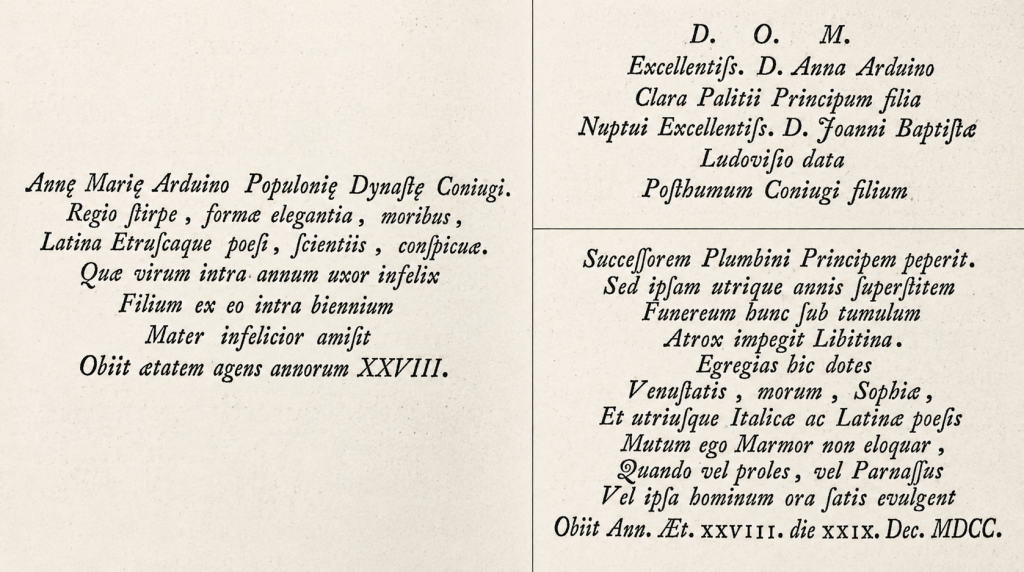
Near-contemporary transcription of inscriptions on the funerary monuments of Niccolò Ludovisi (left), and Anna Maria Arduino Ludovisi (right). Today the original metal lettering is missing in places. Oddly, both commemorate the mother. Source: G. M. Crescimbeni, Notizie storiche degli Arcadi morti I (1720)
It must be pointed out that the detailed August 1699 baptismal certificate for Niccolò Ludovisi, a 19th century copy of which has only recently surfaced in the private portion of the Boncompagni Ludovisi family archive at Casino dell’Aurora, contradicts the narrative of the inscriptions on the paired funerary monuments. The inscriptions state that Anna Maria lost her husband Giambattista Ludovisi within a year of their marriage, and that he predeceased his posthumously-born son, successor to the Principate of Piombino, who in turn lived no more than two years (‘intra biennium’). The mother then died aged 28 (emphasized by both inscriptions) on 29 December 1700, having lost both husband and son. The monuments give no dates whatsoever for the son, who in his sculpture is portrayed as a young boy.
The certificate states that young Niccolò was born 4 August 1699, before what is his father’s attested death date—24 August 1699, with burial in Piombino’s church of San Antimo on 29 August. Niccolò was surely still alive on 24 August 1700, when Anna Maria performed as an Arcadian, with a poem that mourned (only) her husband. So when he passed away, he could have been no more than a 17 month old toddler.
Returning specifically to the portrait medallion at San Diego all’Ospedaletto: the drapery, crown motif, and mourning putti suggest more than the commemoration of an aristocratic woman. They preserve the image of a princess and resilient mother, but not the whole of Anna Maria’s life. Her poetry, along with later praise of her artistic works, preserves another part of her memory. She survives as a voice in Latin and Italian that few women of her era were able to leave so publicly.
Sarah Freeman in September 2026 enters her sophomore year as an undergraduate at the University of Pennsylvania, where she studies Classics. She is a 2025 graduate of the Morristown Beard School in Morristown, New Jersey. During both the summers of 2024 (see here) and 2025 (see here), she also participated in the internship program at the Archivio Digitale Boncompagni Ludovisi. Sarah wrote in 2024 and reiterates now that “I am extremely grateful to HSH Princess Rita Boncompagni Ludovisi for extending the amazing opportunity to work with primary documents in her archive, and to Dr. T. Corey Brennan at Rutgers University–New Brunswick for his endless guidance throughout the process, and for translating the transcriptions of texts. I also give thanks to Nicole Freeto from the Morristown Beard School for inspiring me to study the rich history of Italy and Greece.”
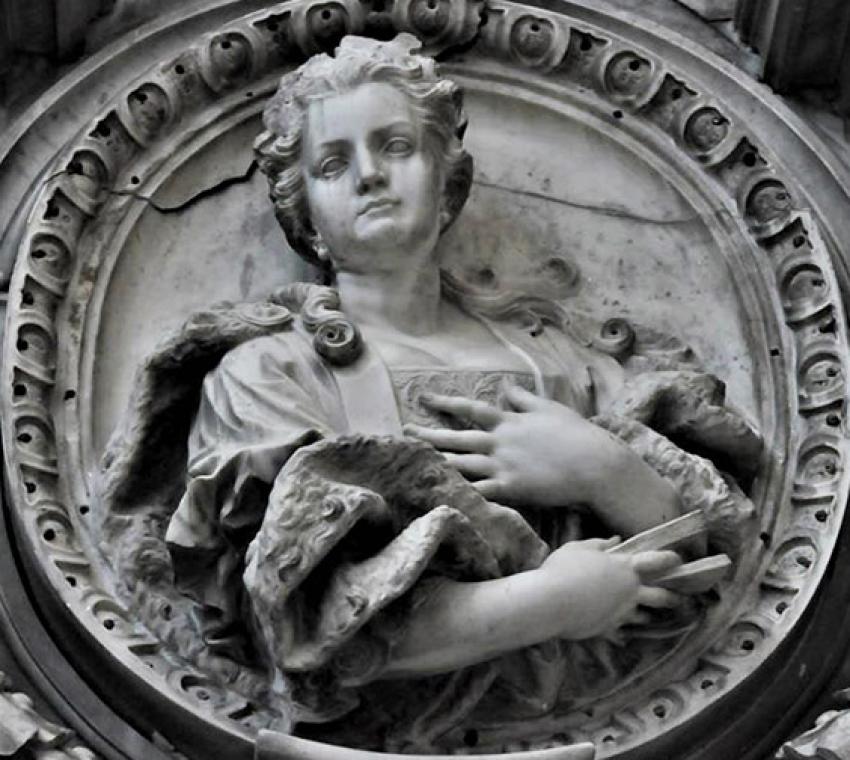
Portrait of the poet and princess Anna Maria Arduino Ludovisi (†1700), from her funerary monument. Credit: Chiesa di S Diego all’Ospedaletto, Napoli


Leave a Reply